

Mohawk Industries Inc. stocks have been trading up by 7.25 percent following upbeat demand forecasts and robust earnings momentum.
What Traders Need To Know
- Q3 adjusted EPS of $2.72 topped the $2.58 consensus, while revenue of $2.79B landed just below the $2.82B estimate.
- A new $500M buyback follows completion of a prior $500M program that retired about 7% of shares at roughly $119.
- Management targets about $375M in baseline annual CapEx while keeping net debt to adjusted EBITDA capped around 2.0x.
- Q4 adjusted EPS guidance of $1.35–$1.45 signals softer near-term earnings in a weak-demand, high-cost environment.
- A Buy initiation from Melius Research with a $188 price target adds a fresh positive catalyst for sentiment.
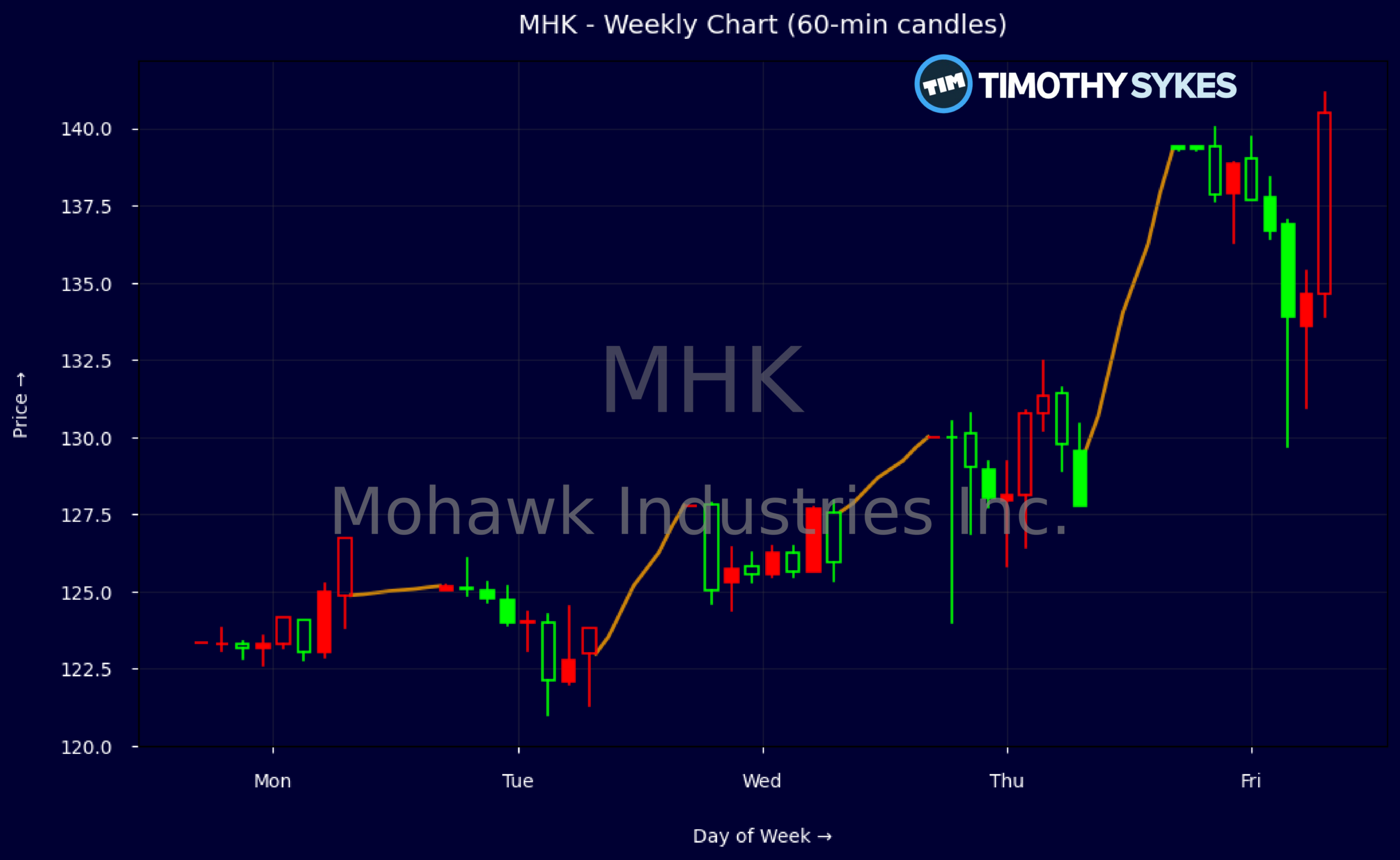
Weekly Update Oct 26 – Oct 30, 2026: On Friday, October 30, 2026 Mohawk Industries Inc. stock [NYSE: MHK] is trending up by 7.25%! Discover the key drivers behind this movement as well as our expert analysis in the detailed breakdown below.
Consumer Discretionary industry expert:
Analyst sentiment – positive
Mohawk’s fundamentals show a cyclical but improving flooring leader with solid balance sheet support. At ~0.7x sales and ~0.9x book, valuation is undemanding relative to history and peers, reflecting muted growth (3‑year revenue CAGR slightly negative, margins compressed). Yet Q2 EBIT margin near 8.5% (company LTM ~4% EBIT) and EBITDA margin >13% underscore early operating leverage from price/mix and productivity. Low leverage (total debt/equity 0.28x, interest coverage >80x) and robust free cash flow (~$228M in Q2) provide ample flexibility.
Technically, MHK has shifted into a short-term momentum uptrend, with the weekly sequence from ~$123 to ~$139 and strong follow-through after the Q3 print indicating an emerging breakout phase. Intraday 5‑minute action (not shown numerically but implied by the close at the high) suggests buyers in control, with rising volume into strength. A clear actionable level is $130: that prior intraday low and breakout zone now acts as firm support; traders can buy pullbacks toward $130 with stops just below $126.
Recent catalysts are decisively constructive: an EPS beat, disciplined capital allocation framework, and a fresh $500M buyback after retiring ~7% of shares around $119 signal management confidence and strong cash generation. Guidance acknowledges weak demand and elevated costs, but Mohawk’s targeted CapEx and net debt/EBITDA ceiling of 2x position it better than many Consumer Discretionary and Home & Homeware names still overlevered. I see upside toward $170–$180 over 12–18 months, with strong support at $125 and resistance near $150.
More Breaking News
Quick Financial Overview
Mohawk Industries Inc. (MHK) just put a solid fundamental backdrop behind a sharp price move. On the weekly tape, MHK ran from roughly $123–$125 early in the week to a $139.41 close, reflecting a strong expansion in value in only a few sessions. The intraday action shows heavy range early around $136–$138, followed by steady bids into the close, with 5‑minute candles grinding higher and finishing near the high of day. For short‑term traders, that close at the top of the range after news is classic continuation fuel.
On the earnings side, Mohawk Industries delivered Q3 adjusted EPS of $2.72 versus $2.58 expected, even as revenue of $2.79B missed slightly versus $2.82B. Margins are thin but workable: EBIT margin near 4.1% and EBITDA margin around 10.2%, on trailing revenue of about $10.79B. Guidance for Q4 adjusted EPS of $1.35–$1.45 confirms that near‑term demand is soft and costs are still elevated, so the current surge is not about a booming cycle, it is about disciplined execution.
Valuation and balance sheet both leave room for trading upside. MHK trades at roughly 15.6x earnings with a price‑to‑sales ratio of about 0.72 and price‑to‑book near 0.94, suggesting the market still prices the stock like a cyclical name, not a growth story. Financial strength metrics are solid: total debt to equity of 0.28, current ratio around 1.9, and strong interest coverage above 80x. Add in a new $500M buyback after already retiring about 7% of the float near $119, and you have a name where corporate cash is a consistent buyer on dips.
Conclusion
Mohawk Industries Inc. is trading like a stock where fundamentals and capital deployment finally line up with price action. The Q3 EPS beat, firm cash flow, and a clear capital allocation framework give MHK a credible story even while management warns that demand will stay weak and costs high. The Q4 EPS range of $1.35–$1.45 keeps expectations realistic, which can help avoid sharp downside shocks if the macro stays choppy.
For traders, the key is to respect both the bullish structure and the cyclical risk. MHK has weekly momentum after running from the low $120s to the high $130s and closing near the top of the range, supported by a fresh $500M buyback and a Buy rating with a $188 target from Melius Research. At the same time, thin profit margins and flat revenue trends mean any downside surprise in demand could hit the tape fast. The setup favors buying strength on orderly pullbacks rather than blindly chasing gaps. This is where risk management becomes crucial for traders; as millionaire penny stock trader and teacher Tim Sykes, says, “The goal is not to win every trade but to protect your capital and keep moving forward.”. As I tell my students, “You do not get paid for predicting the future — you get paid for trading the levels the market is actually respecting.””,”scores”:{“risk-level”:”medium”},”trade”:”true”
This is stock news, not investment advice. Timothy Sykes News delivers real-time stock market news focused on key catalysts driving short-term price movements. Our content is tailored for active traders and investors seeking to capitalize on rapid price fluctuations, particularly in volatile sectors like penny stocks. Readers come to us for detailed coverage on earnings reports, mergers, FDA approvals, new contracts, and unusual trading volumes that can trigger significant short-term price action. Some users utilize our news to explain sudden stock movements, while others rely on it for diligent research into potential investment opportunities.
Dive deeper into the world of trading with Timothy Sykes, renowned for his expertise in penny stocks. Explore his top picks and discover the strategies that have propelled him to success with these articles:
- Penny Stocks Trading Guide
- Best Penny Stocks Under $1 to Buy Today
- Top 8 Penny Stocks to Watch on Robinhood
Once you’ve got some stocks on watch, elevate your trading game with StocksToTrade the ultimate platform for traders. With specialized tools for swing and day trading, StocksToTrade will guide you through the market’s twists and turns.
Dig into StocksToTrade’s watchlists here:





Leave a reply