

CoreWeave Inc. rallies as a landmark AI cloud partnership fuels bullish sentiment, and stocks have been trading up by 3.11 percent.
Key Takeaways
- CoreWeave is entering India via AdaniConneX with 240MW of AI cloud capacity planned in Navi Mumbai, targeting the country’s fast-growing AI ecosystem.
- The company is adding AI computing capacity in Denmark and expanding its data network into the Middle East and Asia, with CRWV up over 1% premarket on the news.
- A new Zero Trust AI security framework and Physical AI Launchables for robotics and self-driving workloads drove about a 3% premarket gain in CRWV.
- Goldman Sachs upgraded CRWV to Buy from Neutral after a debt-driven selloff, helping fuel a roughly 7% rebound in the stock.
- Nvidia’s CEO called CoreWeave financially stronger with a falling cost of capital, saying Nvidia does not expect to provide financial support despite its ~10% stake.
Live Update At 08:32:57 EDT: On Wednesday, October 28, 2026 CoreWeave Inc. stock [NASDAQ: CRWV] is trending up by 3.11%! Discover the key drivers behind this movement as well as our expert analysis in the detailed breakdown below.
Quick Financial Overview
CRWV trades like a high‑beta AI infrastructure name, and the chart backs that up. From 2026/10/05 to 2026/10/27, CoreWeave shares slid from the high $80s to the high $50s, a steep drawdown that reflects concerns about debt, rates, and crowded AI trades. Yet the last two sessions show a sharp bounce, with CRWV jumping from a $51.96 open on 2026/10/26 to a $59.57 close on 2026/10/27. That’s a strong reversal, not a sleepy grind.
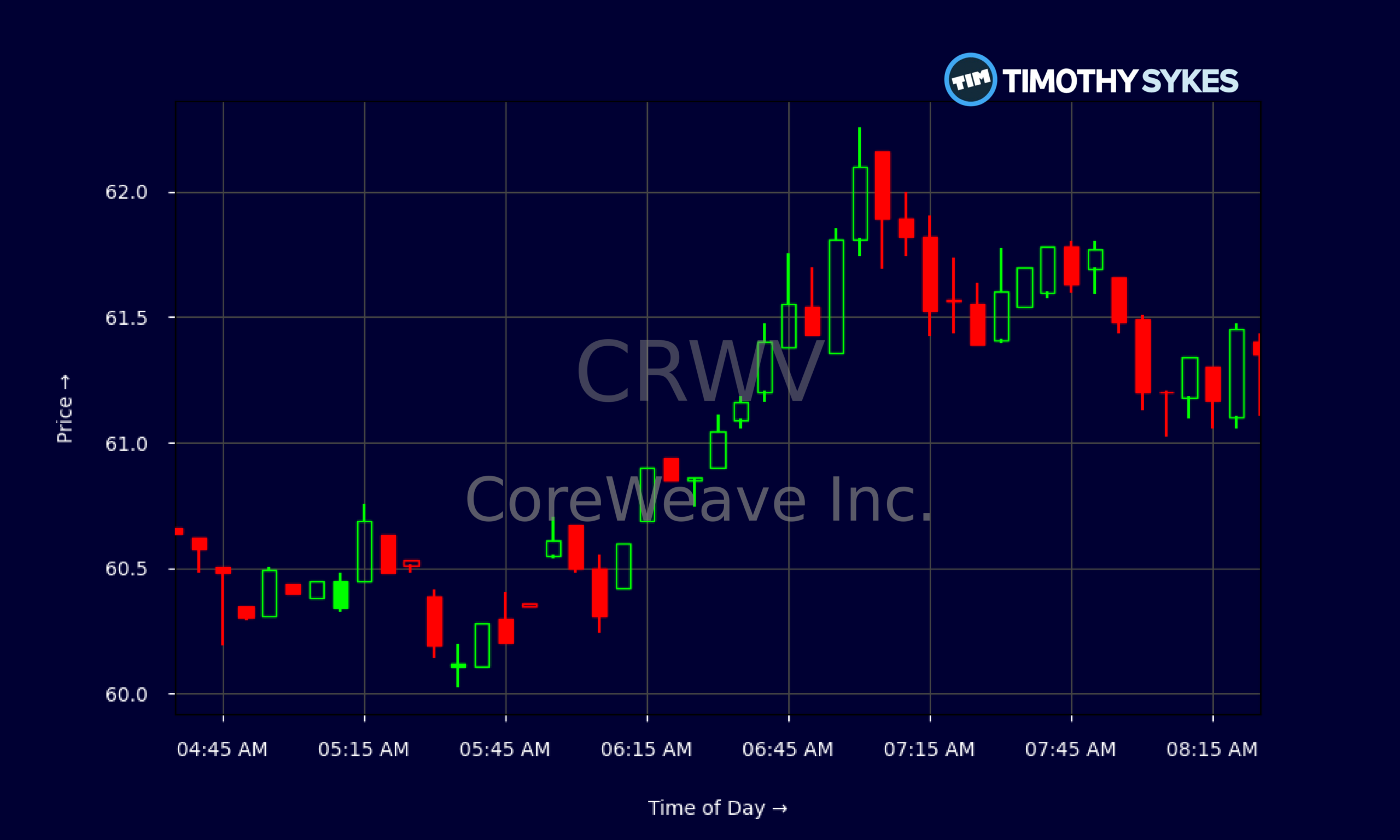
Intraday, the 5‑minute data around $60–$62 shows tight action and higher lows, signaling accumulation rather than panic selling. For short‑term traders, that intraday coil matters. It often sets up secondary moves in either direction once fresh news hits.
More Breaking News
Fundamentally, CoreWeave is still in “build-out mode.” Revenue sits around $5.13B, with a high gross margin near 90.6%, but net income is negative and margins are in the red. CRWV is plowing cash into data centers and hardware. Debt is heavy, with total debt-to-equity above 3 and a leverageratio over 15, and the current ratio of 0.5 shows a tight liquidity profile. For traders, that mix—fast top-line growth, high capex, and leverage—creates volatility and clean momentum setups.
Why Traders Are Watching CRWV Momentum
CRWV is on almost every active trader’s AI radar right now because the company keeps stacking real operational news on top of a very emotional chart. On 2026/10/27, CoreWeave announced new AI computing capacity in Denmark along with network expansion into the Middle East and Asia. That is not a small tweak. It is a statement that CRWV wants a true global AI cloud footprint, not just a regional presence. The stock popping more than 1% premarket around that headline shows traders are rewarding scale.
The India collaboration with AdaniConneX may be even bigger for long-term narrative. CoreWeave plans 240MW of AI cloud capacity in Navi Mumbai across three 80MW buildings, planting a flag directly in one of the fastest-growing AI markets in the world. For momentum traders, that kind of “land grab” story often fuels multi-day runs whenever the broader tape cooperates.
CRWV is also trying to move up the value stack, not just sell raw compute. The Zero Trust AI security framework, designed to keep customer data isolated, plus pre-built Physical AI Launchables for robotics and self-driving workloads, triggered roughly a 3% premarket gain. That tells traders the market sees upside in specialized, higher-margin AI services. Add the Perplexity SPACE integration for defending against rogue AI agents, and you get a clear theme: CoreWeave wants to be known as a secure, enterprise-grade AI cloud, not a commodity GPU renter.
Layer on sentiment shifts. After a debt and credit-risk scare knocked CRWV lower, Goldman Sachs upgraded the stock to Buy from Neutral, helping spark about a 7% rebound. Nvidia’s CEO then publicly described CoreWeave as financially stronger, with a falling cost of capital, and noted Nvidia does not expect to support CRWV financially despite its roughly 10% stake. For traders, those lines directly counter worst-case bailout fears that often haunt heavily leveraged growth names.
Conclusion
CRWV is a textbook high‑volatility AI infrastructure play: big global expansion plans, heavy capex, negative earnings, and constant headlines. CoreWeave is racing into India with AdaniConneX, scaling Denmark, and stretching its network into the Middle East and Asia. At the same time, it is rolling out Zero Trust AI security, robotics-focused Launchables, and Perplexity’s SPACE integration to differentiate its cloud. These aren’t soft press releases; they are tangible signals that CoreWeave wants to lock in enterprise AI workloads worldwide.
But traders cannot ignore the other side of the ledger. The balance sheet shows high leverage, a current ratio below 1, and negative free cash flow as CRWV spends on data centers and hardware. That leverage magnifies every macro swing. When Nasdaq and AI names like CRWV come under pressure, the stock can drop fast, regardless of solid company-specific news.
For active traders, that combination of real catalysts and financial stress creates opportunity and risk. The key is discipline. As Tim Sykes often says, “The market doesn’t care about your opinion, only your plan—cut losses quickly and always respect the price action.” At the same time, trading a volatile ticker like CRWV requires a mindset that accepts inevitable rough patches and focuses on learning from every trade—As millionaire penny stock trader and teacher Tim Sykes, says, “Embrace the journey, the ups and downs; each mistake is a lesson to improve your strategy.”. With CRWV, that means riding momentum around clear news catalysts, respecting support and resistance, and never confusing a strong AI story with a guaranteed outcome. This analysis is for educational and research purposes only, but the message is clear: treat CoreWeave like the fast-moving AI rollercoaster it is, and trade it with a rules-based game plan.
This is stock news, not investment advice. Timothy Sykes News delivers real-time stock market news focused on key catalysts driving short-term price movements. Our content is tailored for active traders and investors seeking to capitalize on rapid price fluctuations, particularly in volatile sectors like penny stocks. Readers come to us for detailed coverage on earnings reports, mergers, FDA approvals, new contracts, and unusual trading volumes that can trigger significant short-term price action. Some users utilize our news to explain sudden stock movements, while others rely on it for diligent research into potential investment opportunities.
Dive deeper into the world of trading with Timothy Sykes, renowned for his expertise in penny stocks. Explore his top picks and discover the strategies that have propelled him to success with these articles:
- Penny Stocks Trading Guide
- Best Penny Stocks Under $1 to Buy Today
- Top 8 Penny Stocks to Watch on Robinhood
Once you’ve got some stocks on watch, elevate your trading game with StocksToTrade the ultimate platform for traders. With specialized tools for swing and day trading, StocksToTrade will guide you through the market’s twists and turns.
Dig into StocksToTrade’s watchlists here:





Leave a reply