

Comcast Corporation Common Stock surged as strategic expansion news lifted investor optimism, and stocks have been trading up by 4.31 percent.
What Traders Need To Know
- Q3 results for CMCSA beat expectations on both earnings per share and revenue, with strong free cash flow and solid contributions from Peacock and Universal’s box office.
- Management guided to a Q4 restructuring charge above $1B and detailed major job cuts and reorganization as Comcast prepares to separate NBCUniversal and Sky into independent companies.
- The board kept its quarterly dividend at $0.33 per share, payable on 2027/01/27, signaling confidence in cash generation during the upcoming transformation.
- Aggressive Xfinity and Comcast Business build-outs across Texas, Virginia, New Hampshire, Indiana, and rural California reinforce Comcast Corporation Common Stock’s focus on multi-gig broadband growth.
- Analysts trimmed CMCSA price targets but mostly maintained Buy or Neutral ratings, reflecting cautious support as the market weighs broadband pressure against transformation upside.
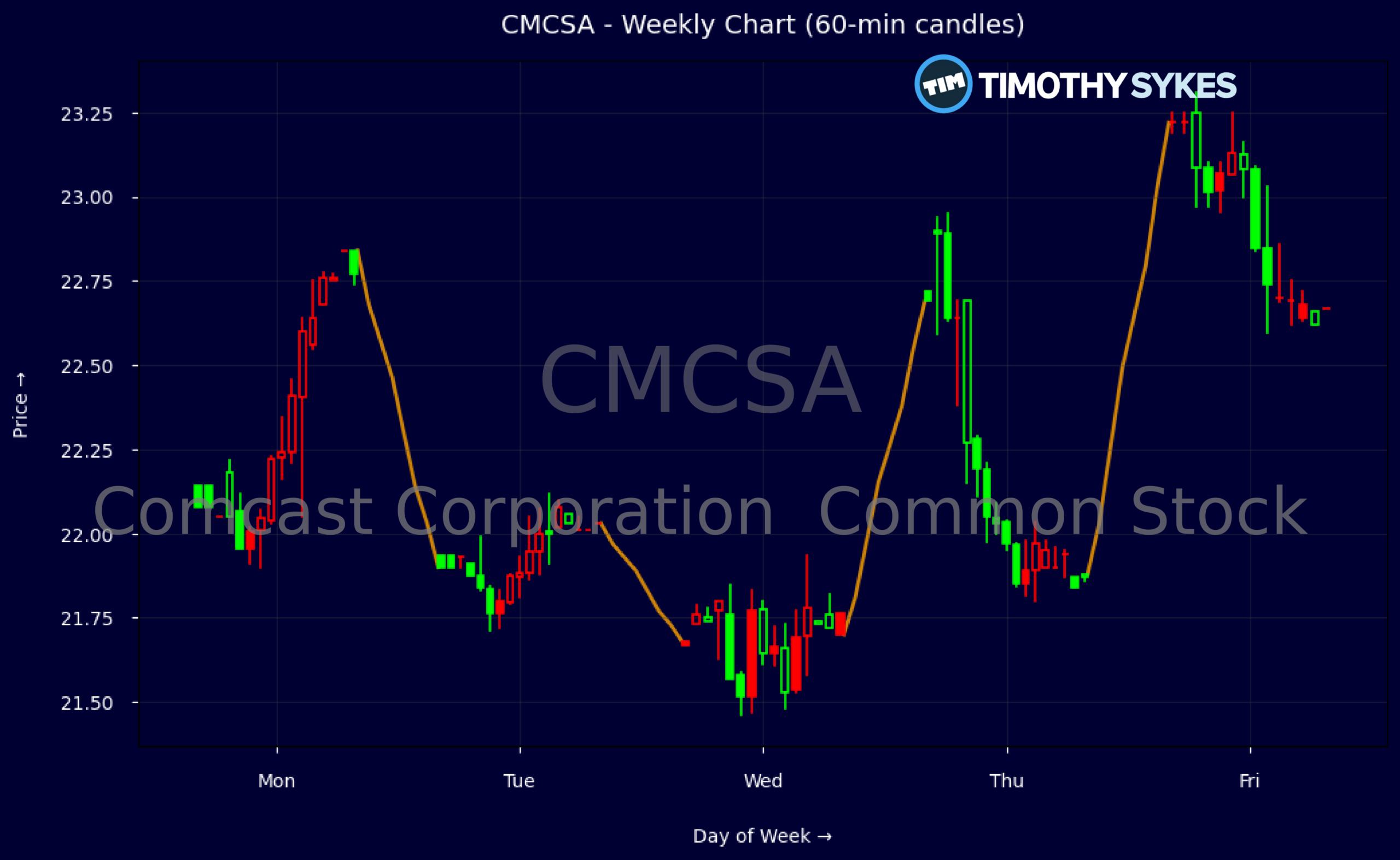
Weekly Update Oct 26 – Oct 30, 2026: On Friday, October 30, 2026 Comcast Corporation Common Stock stock [NASDAQ: CMCSA] is trending up by 4.31%! Discover the key drivers behind this movement as well as our expert analysis in the detailed breakdown below.
Media & Telecommunications industry expert:
Analyst sentiment – positive
Comcast remains a scale leader in U.S. connectivity and media with $123.7B in revenue and attractive economics: 69% gross margin, 27% EBITDA margin, and pre‑tax margin near 15%. Returns on equity near 20% and ROIC above 12% confirm disciplined capital deployment despite leverage (total debt/equity ~1.0x, interest coverage 7.8x). Q3 free cash flow of $4.2B versus a market value implying ~3.4x FCF and 0.6x sales signals deep value; a nearly 6% dividend yield appears well covered by $7.9B operating cash flow.
Technically, CMCSA has shifted from a short-term downdraft to a nascent uptrend: after probing support near $21.70 on October 28, buyers drove a strong rebound to $23.22 by October 30, marking a bullish weekly higher high. Intraday 5‑minute candles show accumulating volume on advances and lighter volume on pullbacks, consistent with accumulation. The first actionable level is support at $21.70–$21.90; long entries above that zone with stops below $21.50 and initial profit-taking near $24.50 are justified.
Fundamentally, Comcast’s Q3 beat on EPS and revenue, strong FCF, profitable Peacock, and record Universal box office clearly outpace most Media & Telecom peers, even as broadband net adds lag and 2027 restructuring charges exceed $1B. Network expansion in Texas, California, and New England reinforces long-term broadband cash flows. With sector valuation multiples much higher than Comcast’s 6.6x P/E and 0.8x book, a conservative 9–10x EPS implies a 12‑month target range of $28–$30, with technical support near $22 and resistance near $25.
More Breaking News
Quick Financial Overview
Comcast Corporation Common Stock printed a solid fundamental quarter. Q3 revenue came in near $29.3B with adjusted EPS around $1.07, both ahead of expectations, backed by $7.9B in operating cash flow and about $4.2B in free cash flow. Margins are healthy for a mature name, with EBITDA margin near 27% and EBIT margin around 15%, while profit margin sits close to 9%. For traders, that tells you CMCSA is still a cash machine even as legacy video and domestic broadband slow.
Valuation is compressed. A price/earnings ratio near 6.6, price/sales around 0.6, and price/free cash flow near 3.4 all point to a market that is discounting restructuring risk and broadband headwinds. Balance sheet leverage is meaningful, with total debt to equity roughly 1.0 and long-term debt near $84B, but interest coverage of about 7.8x suggests the debt load is manageable. A dividend yield around 5.9% and a $0.33 quarterly payout, supported by strong cash flow, anchor the downside for yield-focused traders.
Technically, CMCSA has turned up over the latest weekly bars, rising from the low-$21s toward $23.22. The intraday tape around $23 shows a steady grind higher through the session, with buyers consistently defending dips near $22.90–$23.00 and pushing late strength up to the $23.20–$23.25 zone. That creates a short-term support area just under $23 and immediate resistance around $23.30. For active traders, this tight range around a rising close can set up either a continuation breakout above the intraday high or a fade back toward the $22.70 area if the broader market wobbles.
Conclusion
Strategic Shake-Up Meets Solid Cash Flow
For traders, CMCSA is a classic tension trade between steady fundamentals and looming corporate change. On one side, Comcast Corporation Common Stock is putting up better-than-expected earnings, strong free cash flow, and a firm dividend, all while expanding multi-gig broadband into thousands of new homes and businesses across multiple states. On the other, the company is heading into a heavy restructuring phase with an expected Q4 charge above $1B and significant job cuts tied to reorganizing cable, broadband, and wireless ahead of the planned NBCUniversal and Sky separation.
Sell-side calls echo that mix: price targets have been nudged lower, but Buy and Neutral stances remain, signaling respect for the cash engine yet caution on execution. On the chart, the short-term uptrend toward $23.22, with clear intraday support around $23 and resistance near $23.30, gives CMCSA defined trading levels while the story plays out. Broadly, traders should track headlines around restructuring details, broadband subscriber trends, and any follow-through moves after this earnings beat.
As I tell my students, “When a stock like CMCSA throws off this much cash but sits under a cloud of restructuring, the edge goes to traders who respect the tape, define their risk around key levels, and let the volatility work for them rather than against them.” As millionaire penny stock trader and teacher Tim Sykes, says, “The goal is not to win every trade but to protect your capital and keep moving forward.”. This article is for educational and research purposes, and each trader must decide how that risk/reward fits their own playbook.
“,”scores”:{“risk-level”:”medium”},”trade”:”true
This is stock news, not investment advice. Timothy Sykes News delivers real-time stock market news focused on key catalysts driving short-term price movements. Our content is tailored for active traders and investors seeking to capitalize on rapid price fluctuations, particularly in volatile sectors like penny stocks. Readers come to us for detailed coverage on earnings reports, mergers, FDA approvals, new contracts, and unusual trading volumes that can trigger significant short-term price action. Some users utilize our news to explain sudden stock movements, while others rely on it for diligent research into potential investment opportunities.
Dive deeper into the world of trading with Timothy Sykes, renowned for his expertise in penny stocks. Explore his top picks and discover the strategies that have propelled him to success with these articles:
- Penny Stocks Trading Guide
- Best Penny Stocks Under $1 to Buy Today
- Top 8 Penny Stocks to Watch on Robinhood
Once you’ve got some stocks on watch, elevate your trading game with StocksToTrade the ultimate platform for traders. With specialized tools for swing and day trading, StocksToTrade will guide you through the market’s twists and turns.
Dig into StocksToTrade’s watchlists here:





Leave a reply