

Acco Brands Corporation stocks have been trading up by 24.31 percent following upbeat outlooks and strengthening investor sentiment.
What Traders Need To Know
- Q3 adjusted EPS of $0.28 beat the $0.19 consensus, while $380.3M revenue landed just below the $383.7M estimate, signaling improving earnings leverage.
- Full‑year outlook was raised or affirmed, with 4%‑6% sales growth, $0.98‑$1.02 adjusted EPS vs. $0.88 consensus, and about $100M in 2026 free cash flow.
- Acquisition of Trust pushes Acco Brands Corporation deeper into higher‑growth PC accessories, gaming, smart home, and mobile peripherals across Europe and Latin America.
- Regular $0.075 quarterly dividend, payable 2026/12/09 to holders on 2026/11/20, underlines confidence in cash generation and shareholder returns.
- Integrated Kensington‑EPOS showcase and the new EPOS IMPACT 400 Wireless headset highlight active execution on a hybrid‑work product strategy.
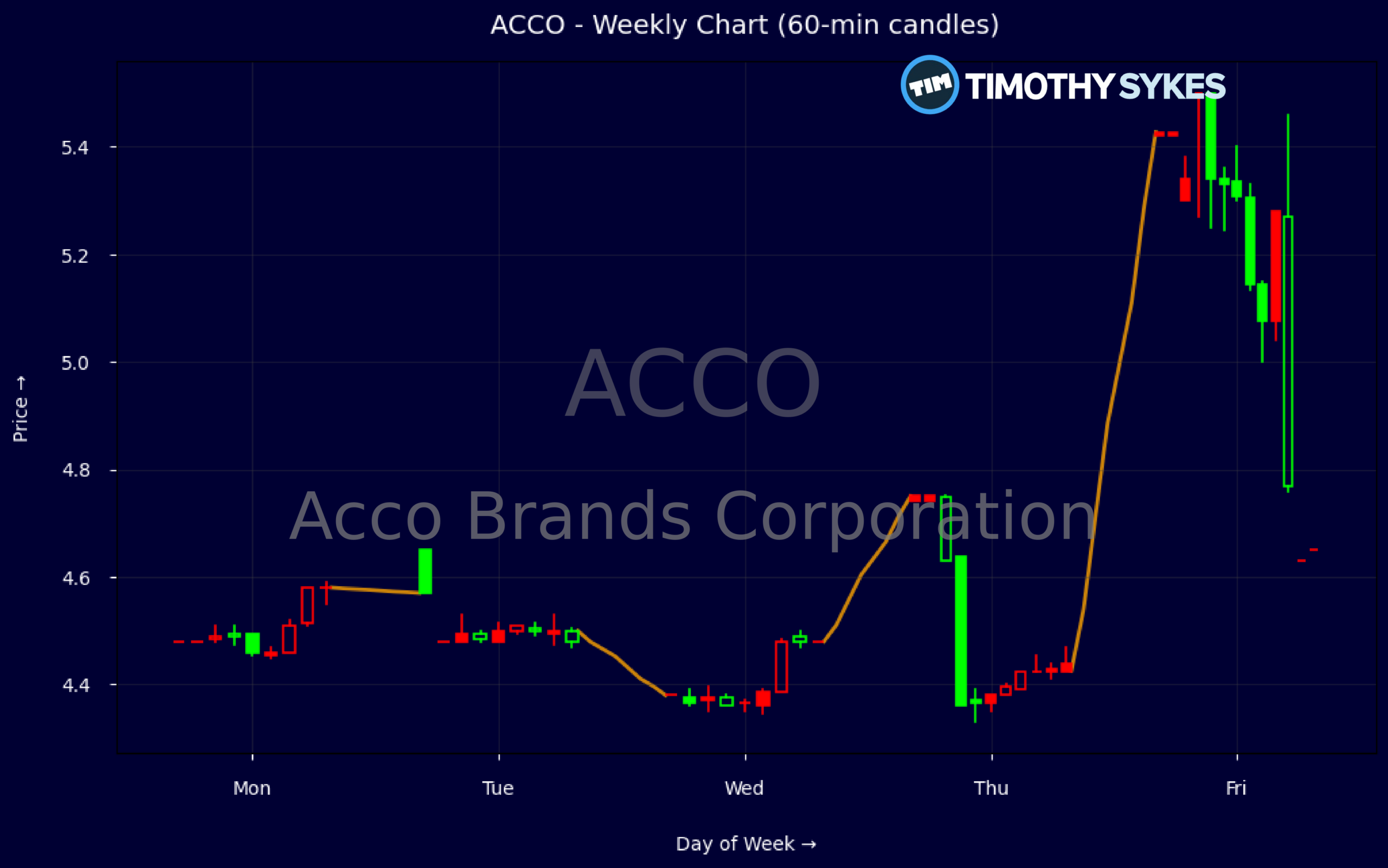
Weekly Update Oct 26 – Oct 30, 2026: On Sunday, November 01, 2026 Acco Brands Corporation stock [NYSE: ACCO] is trending up by 24.31%! Discover the key drivers behind this movement as well as our expert analysis in the detailed breakdown below.
Industrials industry expert:
Analyst sentiment – positive
ACCO occupies a niche oligopoly in legacy office and academic supplies but is clearly in transition. Gross margin at 32.6% and EBITDA margin of 12.6% are solid for a low-growth category, yet pretax margin of 1% underscores heavy interest and restructuring drag. Revenue has shrunk low single digits annually over 3–5 years, but Q3 operating income of $30.3M and $131M LTM free cash flow versus a $1.46B EV and 0.6x P/B signal deep-value characteristics despite 1.46x debt/equity and high goodwill.
Technically, ACCO has broken out from a multi-week base: the sharp move from ~4.40 to a 5.50 high, closing 5.42, reflects a decisive shift in momentum on expanding volume after guidance and earnings. The dominant trend on the weekly timeframe is now up, with prior resistance at ~4.75 turning into first support. An actionable level is 4.75–4.80 for pullback entries, with a tight stop below 4.40; near term, resistance sits at 5.75–6.00.
Fundamentally, ACCO is outperforming Industrials peers on free-cash-flow yield and dividend (5.5%) while lagging on organic growth, but recent catalysts materially improve the outlook. The Trust acquisition, EPOS product launches, and upgraded guidance (4–6% sales growth, ~$100M FCF, EPS $0.98–1.02) pivot the story toward higher-growth, higher-margin peripherals. With leverage forecast around 3.5x and execution improving, I view the stock as a mispriced cash-flow compounder; fair value is $7–8, with key support $4.75 and resistance $6.00.
More Breaking News
Quick Financial Overview
ACCO (Acco Brands Corporation) has shifted from a sleepy office‑supply story into a more active, catalyst‑driven name. The weekly chart shows price stepping from the mid‑$4s to a close above $5, with a spike session opening at $5.50 and holding most of that move. That kind of wide range expansion after earnings and guidance usually tells you new money is coming in, not just shorts covering.
Intraday, a 5‑minute bar ripping from $4.97 to $5.50 and closing at the high shows aggressive demand and almost no intraday fade. For short‑term traders, that type of bar often marks either the start of a trend leg or an exhaustion blow‑off; confirmation depends on how the next few days trade around the $5.00‑$5.50 zone. A sustained base above prior resistance near the mid‑$4s would signal that the market is accepting this higher value area.
Under the hood, the numbers back the move. Q3 revenue of $380.3M supports an annual run‑rate near $1.52B, with an EBIT margin around 7.9% and EBITDA margin of 12.6%, showing solid operating leverage for a low‑multiple name. A P/E near 7.4, price‑to‑sales around 0.26, and price‑to‑book near 0.6 paint ACCO as discounted relative to its earnings and asset base, while a roughly 5.5% dividend yield and $131.4M in recent free cash flow underscore strong cash support.
Conclusion
This is stock news, not investment advice. Timothy Sykes News delivers real-time stock market news focused on key catalysts driving short-term price movements. Our content is tailored for active traders and investors seeking to capitalize on rapid price fluctuations, particularly in volatile sectors like penny stocks. Readers come to us for detailed coverage on earnings reports, mergers, FDA approvals, new contracts, and unusual trading volumes that can trigger significant short-term price action. Some users utilize our news to explain sudden stock movements, while others rely on it for diligent research into potential investment opportunities.
Dive deeper into the world of trading with Timothy Sykes, renowned for his expertise in penny stocks. Explore his top picks and discover the strategies that have propelled him to success with these articles:
- Penny Stocks Trading Guide
- Best Penny Stocks Under $1 to Buy Today
- Top 8 Penny Stocks to Watch on Robinhood
Once you’ve got some stocks on watch, elevate your trading game with StocksToTrade the ultimate platform for traders. With specialized tools for swing and day trading, StocksToTrade will guide you through the market’s twists and turns.
Dig into StocksToTrade’s watchlists here:





Leave a reply