

Weatherford International plc stocks have been trading up by 6.25 percent amid strong investor optimism on improving energy drilling demand.
What Traders Need To Know
- Q3 earnings per share came in at $1.66, beating estimates of $1.27–$1.33 on $1.14B revenue that slightly topped expectations despite a drop from $1.23B a year ago.
- Profitability stepped up with EBITDA margin at 22.2% and about $155M in adjusted free cash flow, showing strong execution even with Middle East disruptions.
- Major banks including RBC, Barclays, Citi, UBS, and Piper Sandler trimmed price targets but kept bullish ratings, pointing to solid fundamentals and above-average growth prospects.
- Goldman Sachs moved its target down to $94 and kept a Neutral stance, offering a more cautious counterweight to the broadly overweight analyst view and $114 mean target.
- Strategic moves such as the NCS Multistage acquisition, redomestication progress, high-coupon note redemption, and new long-duration contracts support a story of rising earnings power and a stronger balance sheet.
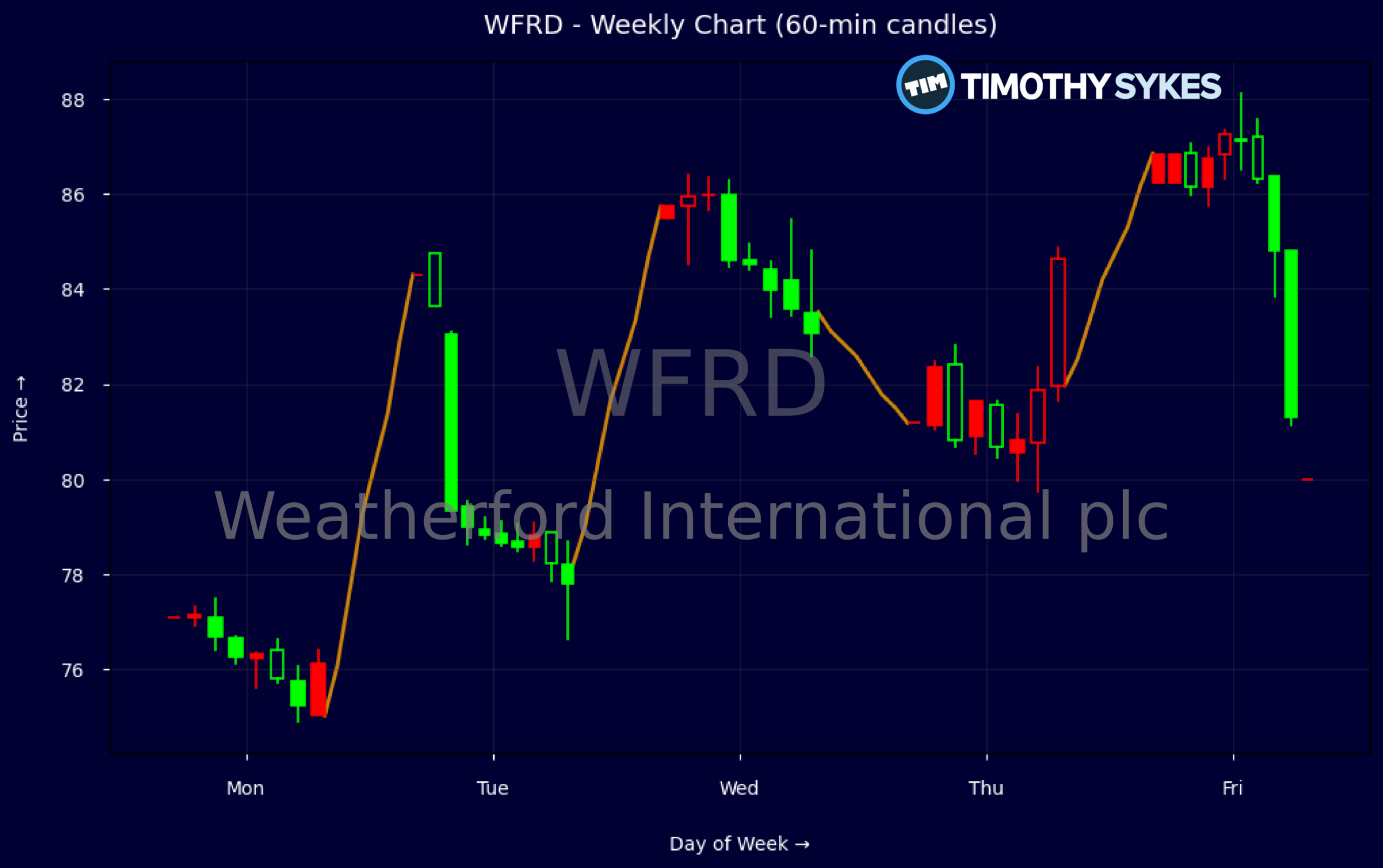
Weekly Update Oct 19 – Oct 23, 2026: On Friday, October 23, 2026 Weatherford International plc stock [NASDAQ: WFRD] is trending up by 6.25%! Discover the key drivers behind this movement as well as our expert analysis in the detailed breakdown below.
Energy industry expert:
Analyst sentiment – positive
Weatherford (WFRD) now sits as a top‑tier oilfield services franchise with a margin and return profile that is clearly above the sector pack. EBIT margin of 10.3% and EBITDA margin of 16.2% on ~$4.9B revenue plus ROE above 22% highlight a structurally improved business. Leverage is reasonable (total debt/equity 0.91, interest coverage 9.5x, current ratio 2.3), while free cash flow of $147M in Q3 and a ~10x P/FCF, ~15x PE valuation remain attractive relative to earnings growth.
Technically, the dominant trend is still up despite volatility. Weekly prints show a steady climb from $77 to $86+ with shallow pullbacks, confirming higher highs and higher lows. Intraday 5‑minute action (post‑earnings spike with elevated volume and tight closing range) indicates active institutional participation around the mid‑80s. $81–82 is now the key actionable support: above it, long bias is warranted; a decisive weekly close below would signal trend fatigue and justify risk reduction.
Fundamentally, Q3 was a clean beat (EPS $1.66 vs $1.27–1.33, EBITDA margin >22%) with robust FCF and ongoing deleveraging, while analysts have only modestly trimmed targets but remain overwhelmingly Overweight/Buy with a ~$114 mean target. Middle East disruptions and softer Q4 are real, yet Weatherford’s profitability and balance sheet compare favorably to broader Energy and OFS peers. I see upside to $105–115 over 12 months, with support near $80 and resistance in the $95–100 zone.
More Breaking News
Quick Financial Overview
Weatherford International plc delivered a clean Q3 2026 beat, with EPS of $1.66 versus consensus around $1.27–$1.33 and revenue of $1.14B slightly ahead of expectations. While revenue fell from $1.23B a year earlier, the real story for traders is the margin shift. EBITDA margin expanded to 22.2%, backed by tight cost control and disciplined project selection, which helped generate about $155M in adjusted free cash flow for the quarter.
At the full-company level, WFRD shows a gross margin near 46.7% and EBITDA margin of 16.2% over the trailing period, with net profit margins around 7%–8%. Return on equity above 22% and return on capital in the mid-teens point to efficient use of capital. Leverage looks manageable, with total debt-to-equity around 0.91, interest coverage near 9.5, and a current ratio of 2.3. A trailing P/E of roughly 15 and price-to-sales near 1.2 keep valuation in a mid-range zone for an oilfield services name.
On the tape, WFRD has bounced from the mid-$70s to the mid-$80s this week, with the latest close around $86 after intraday action mostly holding above $86 once the morning dip cleared. The 5-minute chart shows steady higher lows through most of the day, suggesting controlled dip buying rather than panic selling. With consensus analyst targets around $114 against a recent quote near $82–$86 and an annual dividend rate of $1.10 (about 1.3% yield) supported by $192M in quarterly operating cash flow and $147M in free cash flow, traders are looking at a name where earnings quality and cash generation are improving faster than top-line growth.
Conclusion
This is stock news, not investment advice. Timothy Sykes News delivers real-time stock market news focused on key catalysts driving short-term price movements. Our content is tailored for active traders and investors seeking to capitalize on rapid price fluctuations, particularly in volatile sectors like penny stocks. Readers come to us for detailed coverage on earnings reports, mergers, FDA approvals, new contracts, and unusual trading volumes that can trigger significant short-term price action. Some users utilize our news to explain sudden stock movements, while others rely on it for diligent research into potential investment opportunities.
Dive deeper into the world of trading with Timothy Sykes, renowned for his expertise in penny stocks. Explore his top picks and discover the strategies that have propelled him to success with these articles:
- Penny Stocks Trading Guide
- Best Penny Stocks Under $1 to Buy Today
- Top 8 Penny Stocks to Watch on Robinhood
Once you’ve got some stocks on watch, elevate your trading game with StocksToTrade the ultimate platform for traders. With specialized tools for swing and day trading, StocksToTrade will guide you through the market’s twists and turns.
Dig into StocksToTrade’s watchlists here:





Leave a reply