
timothy sykes logo
Intel Rises 2% Despite Shareholder Lawsuit Reminder Thumbnail

Intel Rises 2% Despite Shareholder Lawsuit Reminder

TIMOTHY SYKES•UPDATED NOV. 17, 2026, 11:05 AM ET

Intel gained 2% after the close while allegations about weaker computer demand remained unresolved.
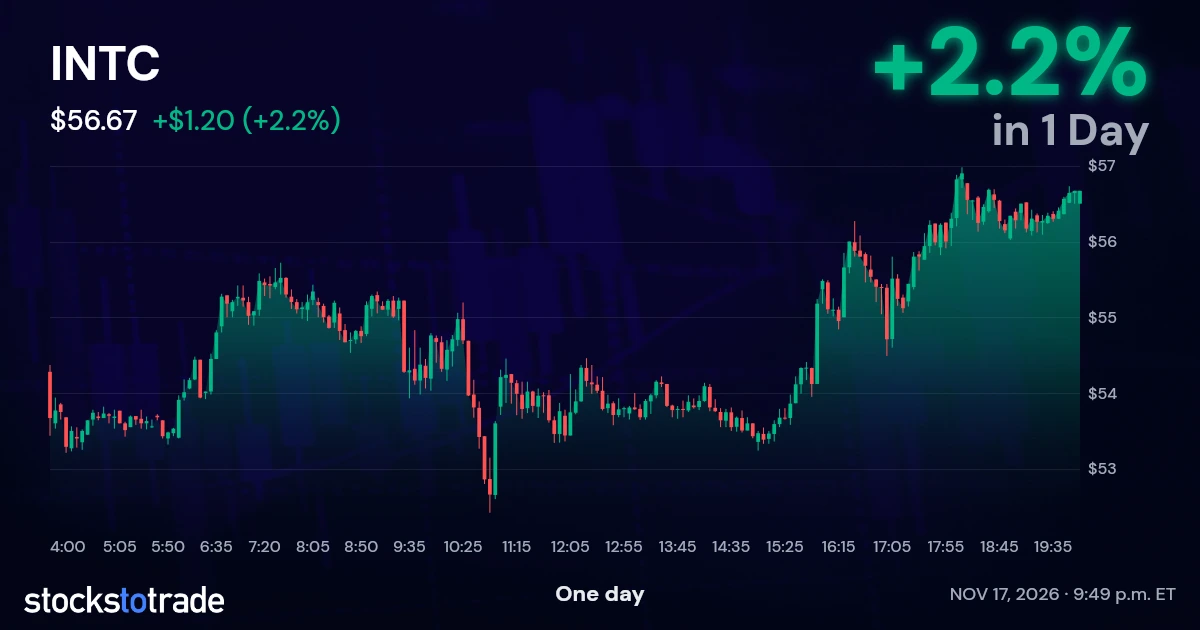
INTC Candlestick Chart

Why Intel Stock Is Up After Market Close

Intel Corporation (NASDAQ: INTC) last traded at $56.67 after the regular market closed, up 2% from the prior session’s close of $55.47. No company news or filing explains the gain; Levi & Korsinsky, a shareholder law firm, issued a reminder about an existing investor lawsuit. That notice announced no settlement or new business to support higher earnings.

Intel Lawsuit Challenges Computer Sales Disclosures

The complaint alleges Intel understated how much weaker personal-computer demand hurt its computer-chip business. It claims the slowdown reduced quarterly revenue and the share of sales left after production costs more than investors had been told. These are allegations, not court findings.

Intel Rises Despite Shareholder Lawsuit Notice

The legal notice seeks investors for a class action, a lawsuit seeking recovery for a group over alleged securities-law violations. The stock’s rise ran counter to the notice’s negative claims. The gain alone does not show that investors consider the legal risk resolved.

Intel Investor Lawsuit Deadline

Investors have until January 12, 2027 to seek appointment as lead plaintiff, the investor chosen by the court to represent the group. That deadline concerns who leads the case, rather than whether Intel owes damages.

Quick Financial Overview

Intel is profitable and is a large company based on $301.19B in combined share value. It reported $54.01B in cash, cash equivalents, and short-term investments as of September 26, 2026, including cash and investments that can be turned into cash quickly.

What Intel Corporation Does

Intel supplies processors, chips that carry out instructions in personal computers and servers. Servers run software and handle data for businesses, giving Intel customers beyond the home-computer market.

Intel Quarterly Revenue And Earnings

For that quarter, Intel reported revenue of $16.51B and net income of $3.32B. Revenue measures sales, while net income is the profit left after expenses. Those results show an established business, but they do not settle concerns about future computer demand.

Intel Stock Rebounds Below the $90 level

Intel traded around the $90 level a month ago, leaving the current rebound within a sharp monthly decline. The gain after the regular close has recovered only part of that lost ground. It has not reversed the broader slide.

ASUS Showcases Intel Server Processors

ASUS, a computer and server maker, showcased systems using Intel server processors alongside competing platforms. The announcement showed where Intel products are being used, but disclosed no new Intel contract value or guaranteed orders. Product inclusion does not establish how much added revenue Intel will earn.

Conclusion

The next operating report can show whether Intel’s computer and server businesses are strengthening together. A recovery across both markets would give earnings more support than demand confined to servers.

This is stock news, not investment advice. Timothy Sykes News delivers real-time stock market news focused on key catalysts driving short-term price movements. Our content is tailored for active traders and investors seeking to capitalize on rapid price fluctuations, particularly in volatile sectors like penny stocks. Readers come to us for detailed coverage on earnings reports, mergers, FDA approvals, new contracts, and unusual trading volumes that can trigger significant short-term price action. Some users utilize our news to explain sudden stock movements, while others rely on it for diligent research into potential investment opportunities.

Dive deeper into the world of trading with Timothy Sykes, renowned for his expertise in penny stocks. Explore his top picks and discover the strategies that have propelled him to success with these articles:

Once you’ve got some stocks on watch, elevate your trading game with StocksToTrade the ultimate platform for traders. With specialized tools for swing and day trading, StocksToTrade will guide you through the market’s twists and turns.
Dig into StocksToTrade’s watchlists here:



How much has this post helped you?


Leave a reply

* Results are not typical and will vary from person to person. Making money trading stocks takes time, dedication, and hard work. There are inherent risks involved with investing in the stock market, including the loss of your investment. Past performance in the market is not indicative of future results. Any investment is at your own risk. See Terms of Service here

The available research on day trading suggests that most active traders lose money. Fees and overtrading are major contributors to these losses.

A 2000 study called “Trading is Hazardous to Your Wealth: The Common Stock Investment Performance of Individual Investors” evaluated 66,465 U.S. households that held stocks from 1991 to 1996. The households that traded most averaged an 11.4% annual return during a period where the overall market gained 17.9%. These lower returns were attributed to overconfidence.

A 2014 paper (revised 2019) titled “Learning Fast or Slow?” analyzed the complete transaction history of the Taiwan Stock Exchange between 1992 and 2006. It looked at the ongoing performance of day traders in this sample, and found that 97% of day traders can expect to lose money from trading, and more than 90% of all day trading volume can be traced to investors who predictably lose money. Additionally, it tied the behavior of gamblers and drivers who get more speeding tickets to overtrading, and cited studies showing that legalized gambling has an inverse effect on trading volume.

A 2019 research study (revised 2020) called “Day Trading for a Living?” observed 19,646 Brazilian futures contract traders who started day trading from 2013 to 2015, and recorded two years of their trading activity. The study authors found that 97% of traders with more than 300 days actively trading lost money, and only 1.1% earned more than the Brazilian minimum wage ($16 USD per day). They hypothesized that the greater returns shown in previous studies did not differentiate between frequent day traders and those who traded rarely, and that more frequent trading activity decreases the chance of profitability.

These studies show the wide variance of the available data on day trading profitability. One thing that seems clear from the research is that most day traders lose money .

Millionaire Media 66 W Flagler St. Ste. 900 Miami, FL 33130 United States (888) 878-3621 This is for information purposes only as Millionaire Media LLC nor Timothy Sykes is registered as a securities broker-dealer or an investment adviser. No information herein is intended as securities brokerage, investment, tax, accounting or legal advice, as an offer or solicitation of an offer to sell or buy, or as an endorsement, recommendation or sponsorship of any company, security or fund. Millionaire Media LLC and Timothy Sykes cannot and does not assess, verify or guarantee the adequacy, accuracy or completeness of any information, the suitability or profitability of any particular investment, or the potential value of any investment or informational source. The reader bears responsibility for his/her own investment research and decisions, should seek the advice of a qualified securities professional before making any investment, and investigate and fully understand any and all risks before investing. Millionaire Media LLC and Timothy Sykes in no way warrants the solvency, financial condition, or investment advisability of any of the securities mentioned in communications or websites. In addition, Millionaire Media LLC and Timothy Sykes accepts no liability whatsoever for any direct or consequential loss arising from any use of this information. This information is not intended to be used as the sole basis of any investment decision, nor should it be construed as advice designed to meet the investment needs of any particular investor. Past performance is not necessarily indicative of future returns.

Citations for Disclaimer

Barber, Brad M. and Odean, Terrance, Trading is Hazardous to Your Wealth: The Common Stock Investment Performance of Individual Investors. Available at SSRN: “Day Trading for a Living?”

Barber, Brad M. and Lee, Yi-Tsung and Liu, Yu-Jane and Odean, Terrance and Zhang, Ke, Learning Fast or Slow? (May 28, 2019). Forthcoming: Review of Asset Pricing Studies, Available at SSRN: “https://ssrn.com/abstract=2535636”

Chague, Fernando and De-Losso, Rodrigo and Giovannetti, Bruno, Day Trading for a Living? (June 11, 2020). Available at SSRN: “https://ssrn.com/abstract=3423101”