

Vertiv Holdings LLC stocks have been trading up by 17.24 percent amid strong AI-driven data center infrastructure demand.
Key Takeaways For VRT Traders
- Nvidia and Vertiv unveiled a configurable AI factory design that can lift first‑year token output by up to 30% without adding capacity, now being deployed by Polar Data Centers in Norway.
- New partnerships with Dassault Systèmes add virtual‑twin design and agentic AI to simulate Nvidia DSX AI factories, aiming to cut design and deployment timelines by roughly 60%.
- SmartIT, Vertiv’s new pre‑engineered AI data‑center platform, targets faster, simpler high‑density AI rollouts across enterprise, colo, and hyperscale environments.
- The King Environmental Services acquisition broadens Vertiv’s liquid‑cooling and commissioning footprint across Europe, reinforcing its global AI thermal services stack.
- Roth, Mizuho, Morgan Stanley, and RBC trimmed VRT price targets but kept bullish ratings, with Street averages still clustering around the low‑to‑mid $300 range.
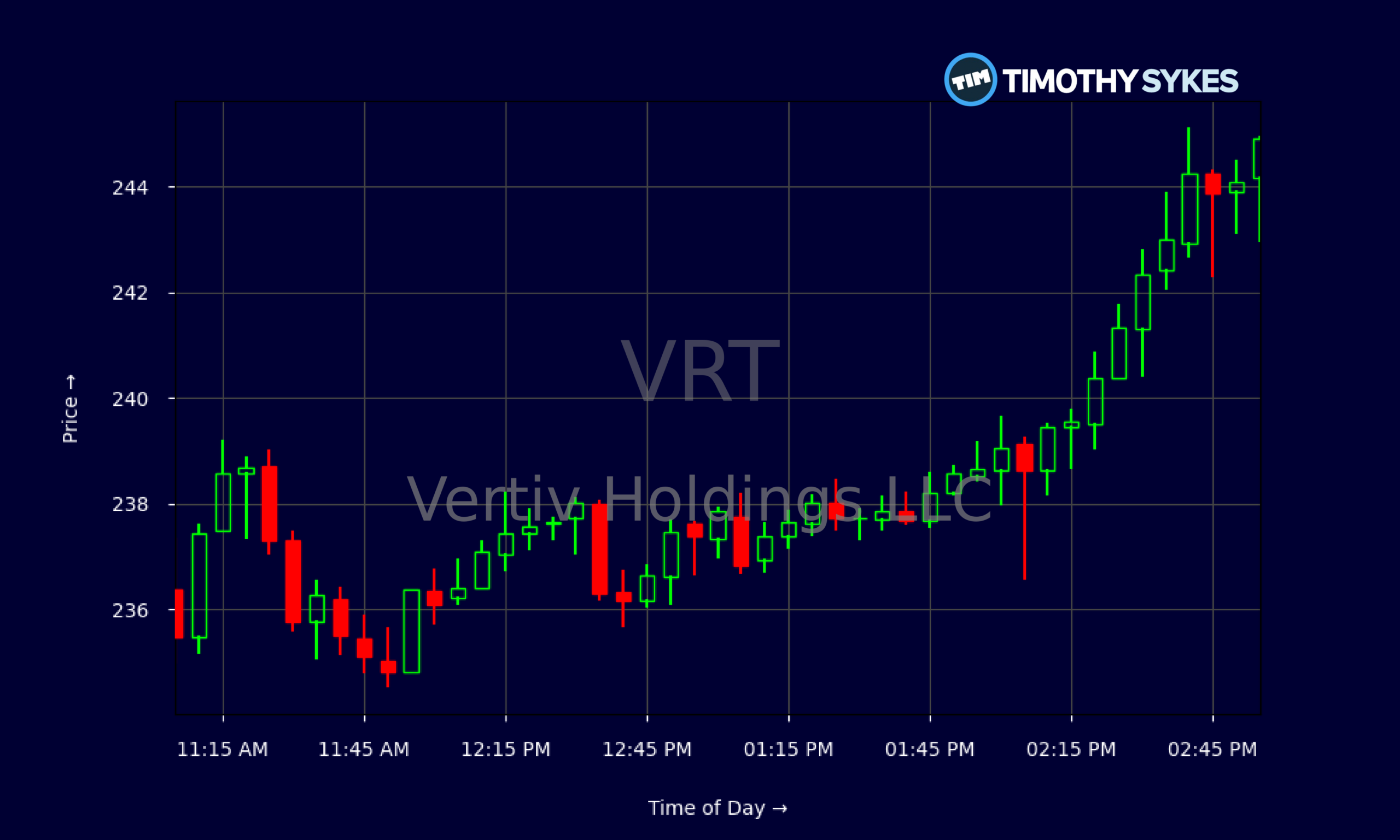
Live Update At 15:02:33 EDT: On Wednesday, October 28, 2026 Vertiv Holdings LLC stock [NYSE: VRT] is trending up by 17.24%! Discover the key drivers behind this movement as well as our expert analysis in the detailed breakdown below.
Quick Financial Overview
VRT has been trading like a high‑beta AI infrastructure proxy, and the tape shows it. After sliding to the low $190s earlier in October, Vertiv shares have ripped back toward the mid‑$240s, with the latest close near $244.54. That is a sharp rebound over just a couple of weeks, showing aggressive dip‑buying each time the stock tested the $200 zone.
Intraday action tells the same story. On the latest session, VRT opened weak near $232.52, flushed down to $228.81, then ground higher all day to reclaim the mid‑$240s. That kind of fade‑then‑grind pattern usually signals strong demand absorbing supply.
Fundamentally, Vertiv is putting up the kind of numbers the market expects from an AI data‑center enabler. Revenue over the last year sits around $10.23B with double‑digit growth, while EBIT margin near 18.9% and EBITDA margin above 22% backstop the story. Returns on equity above 40% and solid interest coverage (~41x) show a business throwing off cash with manageable leverage.
More Breaking News
The flip side: VRT carries a rich P/E above 50 and price‑to‑sales north of 8. For traders, that means any stumble on AI orders or margins can trigger sharp pullbacks, but strong execution keeps fueling powerful trend legs.
Why Traders Are Watching VRT’s AI Factory Story
VRT is not trading like a boring industrial name anymore; it trades like a frontline AI infrastructure play. The core driver is Vertiv’s deepening relationship with Nvidia around so‑called “AI factories.” Vertiv and Nvidia jointly rolled out a configurable AI factory architecture that can boost cumulative token output by up to 30% in the first year without adding capacity. That is a big claim, and it is not just PowerPoint. Polar Data Centers is rolling the design into an initial 41MW phase in Norway, with headroom to scale to 100MW.
For traders, this matters because it shows Vertiv moving from parts supplier to co‑architect of how AI data centers get built. When VRT helps customers squeeze more tokens out of the same megawatts, it becomes harder to rip them out of the stack later. That can translate into recurring design wins and longer visibility.
The story goes deeper. Vertiv is teaming with Dassault Systèmes to bring 3DEXPERIENCE virtual‑twin and agentic AI tools into the process. The goal: simulate power, cooling, and infrastructure for Nvidia DSX AI factories before a shovel hits the ground, potentially cutting design and deployment times by about 60%. Faster time‑to‑capacity is gold for AI customers racing to monetize models, and VRT is positioning itself right at that pain point.
Layer on SmartIT, Vertiv’s new pre‑engineered AI data‑center platform validated with NVIDIA MGX and OCP ORV3, plus the global Nvidia‑backed Vera Rubin AI factories with Dell, HPE, and Eaton from 2027 onward, and traders get a clear message. VRT is building an ecosystem around AI factories, not just selling boxes.
Conclusion
The near‑term tape around VRT has been noisy. The stock dropped roughly 18% earlier in October on worries about AI funding and data‑center capex, and several brokers responded by trimming targets. Roth Capital cut its VRT target to $335 from $355, Morgan Stanley moved from $350 to $330, Mizuho eased from $300 to $280, and RBC nudged from $337 to $323. But none of them bailed. Ratings stay in Buy, Outperform, or Overweight territory, and Street averages still hover around $330.
At the same time, Vertiv keeps stacking AI‑centric catalysts: the Nvidia AI factory architecture, virtual‑twin design with Dassault Systèmes, the SmartIT platform, and the King Environmental Services deal to deepen liquid‑cooling services in Europe. Add in strong profitability and cash generation, and you get a name where the fundamental trend still points up while the valuation forces wild swings.
For active traders, that combination is exactly why VRT deserves a spot on the screen. As millionaire penny stock trader and teacher Tim Sykes, says, “There is always another play around the corner; don’t chase just because you feel FOMO.”. In the words of Tim Sykes, “Patterns repeat because human nature doesn’t change — your job is to recognize the pattern, manage your risk, and never fall in love with the stock.” VRT’s AI factory story is powerful, but the only way to trade a volatile leader like this is with a plan, strict risk control, and a focus on price action over hype. This analysis is for educational and research purposes only and is not investment advice.
This is stock news, not investment advice. Timothy Sykes News delivers real-time stock market news focused on key catalysts driving short-term price movements. Our content is tailored for active traders and investors seeking to capitalize on rapid price fluctuations, particularly in volatile sectors like penny stocks. Readers come to us for detailed coverage on earnings reports, mergers, FDA approvals, new contracts, and unusual trading volumes that can trigger significant short-term price action. Some users utilize our news to explain sudden stock movements, while others rely on it for diligent research into potential investment opportunities.
Dive deeper into the world of trading with Timothy Sykes, renowned for his expertise in penny stocks. Explore his top picks and discover the strategies that have propelled him to success with these articles:
- Penny Stocks Trading Guide
- Best Penny Stocks Under $1 to Buy Today
- Top 8 Penny Stocks to Watch on Robinhood
Once you’ve got some stocks on watch, elevate your trading game with StocksToTrade the ultimate platform for traders. With specialized tools for swing and day trading, StocksToTrade will guide you through the market’s twists and turns.
Dig into StocksToTrade’s watchlists here:





Leave a reply