

Robert Half Inc Com stocks have been trading up by 20.24 percent on strong earnings and upgraded forward guidance.
Key Takeaways
- Q3 2026 EPS landed at $0.49, topping the $0.47 consensus and last year’s $0.43, on $1.36B in revenue that stayed essentially flat versus a year ago.
- Talent Solutions finally flipped back to roughly 2% adjusted year‑over‑year growth, the first positive print for Robert Half since 2022, while Protiviti revenue was still slightly down.
- Margins for Robert Half improved meaningfully versus 2025, pushing net income up to $50M even though nine‑month revenue is still trailing last year.
- The 2027 Salary Guide shows employers paying above planned ranges, especially for specialized and AI‑related skills, pointing to durable demand for staffing and consulting.
- Protiviti, part of RHI, keeps stacking accolades from Fortune, Forbes, Seramount, and Microsoft’s AI Business Solutions Inner Circle, underscoring brand strength in tech and AI consulting.
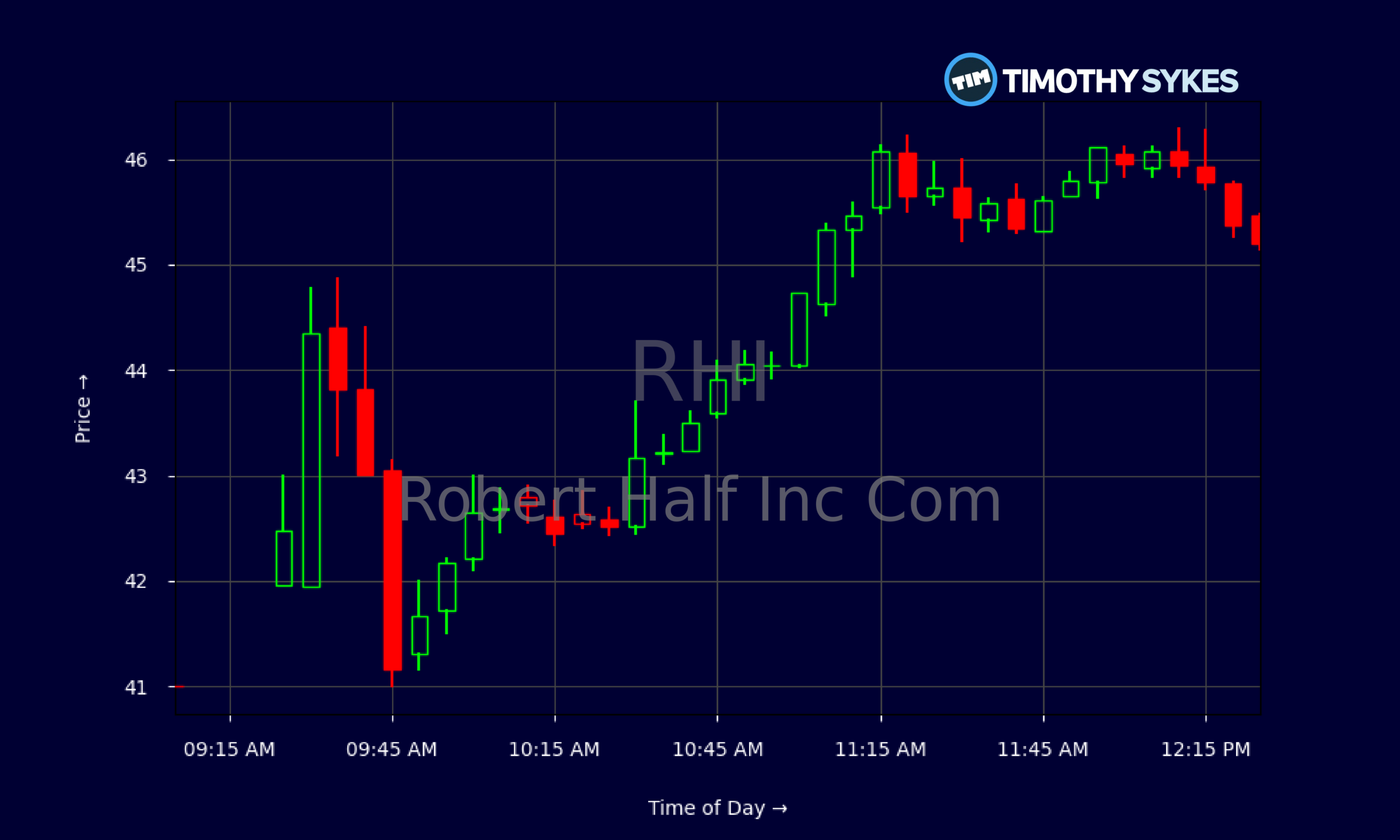
Live Update At 12:32:30 EDT: On Friday, October 23, 2026 Robert Half Inc Com stock [NYSE: RHI] is trending up by 20.24%! Discover the key drivers behind this movement as well as our expert analysis in the detailed breakdown below.
Quick Financial Overview
Robert Half Inc Com (RHI) just gave traders a clear catalyst. After drifting in the mid‑$30s for most of October, RHI exploded from a $37.68 close on 2026/10/22 to $45.27 on 2026/10/23. That is a sharp post‑earnings repricing, not random noise.
Intraday, RHI opened strong near $44, briefly washed out to $41, then ripped back through $46 before settling in the mid‑$45s. That kind of wide, high‑volume range tells you shorts were trapped and late longs were chasing. For momentum traders, this is exactly the type of earnings‑driven trend day you study.
Fundamentals back up the move. RHI posted Q3 EPS of $0.49, beating the $0.47 Wall Street target and improving from $0.43 a year earlier, on revenue of about $1.36B that was basically flat. Margins, not sales, did the heavy lifting. With a price‑to‑sales ratio around 0.66 and a P/E near 29.5, the market is paying up for a quality staffing and consulting name that is stabilizing.
More Breaking News
Financial strength looks solid: low debt, a current ratio near 1.5, and healthy cash flow. For traders, that means RHI has room to ride out a choppy hiring cycle while the chart transitions from basing to breakout mode.
Why Traders Are Watching RHI After Q3
RHI is back on screens because the story finally shifted from pure defense to quiet offense. The headline numbers look modest — Q3 2026 revenue at roughly $1.359B, essentially flat year over year — but under the hood, the engine is starting to turn. Net income climbed to $50M from $43M, and EPS moved to $0.49 from $0.43, outperforming expectations even without top‑line growth.
For a cyclical staffing name like Robert Half, that matters. It tells traders management cut fat, protected pricing, and focused on higher‑value work. The Talent Solutions segment, RHI’s core staffing and placement franchise, posted about 2% adjusted year‑over‑year growth, its first positive adjusted print since 2022. That is the kind of inflection traders hunt: not explosive yet, but a clear turn from contraction to growth.
Protiviti, the consulting arm of Robert Half, is softer on revenue, but it is quietly building a long game that traders cannot ignore. It stayed slightly down on the top line, yet it landed back‑to‑back recognition from Fortune and Forbes, plus three major Seramount awards around talent inclusion and culture. On top of that, Protiviti made Microsoft’s 2026‑2027 AI Business Solutions Inner Circle again, marking it as a top global AI and Dynamics partner.
Stack that next to Robert Half’s 2027 Salary Guide, which shows employers paying above planned ranges for specialized and AI‑related skills, and you get a clear theme. Skills scarcity and AI transformation are tailwinds for RHI’s model. That is why the stock reacted so aggressively once traders saw the Q3 numbers line up with this demand story.
Conclusion
For active traders, RHI now sits at the crossroads of macro labor trends and a specific earnings turn. Robert Half showed it can grow profits even while revenue is flat, thanks to tighter costs and better mix. Talent Solutions is back to positive adjusted growth, Protiviti is winning credibility in AI and digital projects, and the 2027 Salary Guide confirms that clients are still paying up for specialized expertise. None of this guarantees a straight‑up chart from here, but it explains the violent repricing we just saw.
Culture and leadership are an underrated part of this tape. Robert Half and Protiviti keep landing on lists: World’s Top Companies for Women 2026, multiple Seramount honors, and the Staffing Industry Analysts Global Power 150 Women in Staffing naming senior leaders Angela Lurie and Sara Gagen. For a people‑heavy business like RHI, that can translate into lower turnover, better delivery, and stickier clients — all supportive for longer‑term trading theses.
That said, traders still need to respect risk. Earnings beats can fade, and flat revenue plus a mid‑to‑high‑20s P/E leaves no room for major disappointment. As Tim Sykes likes to remind his community, “Patterns repeat, but they don’t repeat forever — that’s why you take singles and protect yourself first.” As millionaire penny stock trader and teacher Tim Sykes, says, “Consistency is key in trading; don’t let emotions dictate your trades.”. Use RHI’s improving fundamentals and strong post‑earnings trend as a case study, not a blind signal, and always let the chart and your trading rules lead the way.
This is stock news, not investment advice. Timothy Sykes News delivers real-time stock market news focused on key catalysts driving short-term price movements. Our content is tailored for active traders and investors seeking to capitalize on rapid price fluctuations, particularly in volatile sectors like penny stocks. Readers come to us for detailed coverage on earnings reports, mergers, FDA approvals, new contracts, and unusual trading volumes that can trigger significant short-term price action. Some users utilize our news to explain sudden stock movements, while others rely on it for diligent research into potential investment opportunities.
Dive deeper into the world of trading with Timothy Sykes, renowned for his expertise in penny stocks. Explore his top picks and discover the strategies that have propelled him to success with these articles:
- Penny Stocks Trading Guide
- Best Penny Stocks Under $1 to Buy Today
- Top 8 Penny Stocks to Watch on Robinhood
Once you’ve got some stocks on watch, elevate your trading game with StocksToTrade the ultimate platform for traders. With specialized tools for swing and day trading, StocksToTrade will guide you through the market’s twists and turns.
Dig into StocksToTrade’s watchlists here:





Leave a reply