

BrightSpring Health Services Inc. shares surged as positive coverage drove buying interest, with stocks have been trading up by 10.92 percent.
What Traders Need To Know
- Strong Q3 2026 print showed 26% revenue growth and 42% Adjusted EBITDA growth, with net income from continuing operations nearly tripling and leverage cut to 1.79x.
- Core Q3 revenue of $4.21B smashed the $3.88B Street estimate, while adjusted EPS of $0.54 topped the $0.47 consensus despite a $0.01 GAAP EPS miss.
- Management raised FY26 revenue guidance to $15.9B-$16.125B and lifted FY26 Adjusted EBITDA to $850M-$860M, well ahead of prior outlook and Street expectations.
- Recently acquired Amedisys and LHC branches are contributing to higher 2026 revenue and EBITDA guidance, reinforcing the M&A-driven growth story.
- Shares jumped about 8% in premarket trading after the beat-and-raise Q3, signaling a bullish shift in sentiment toward BTSG.
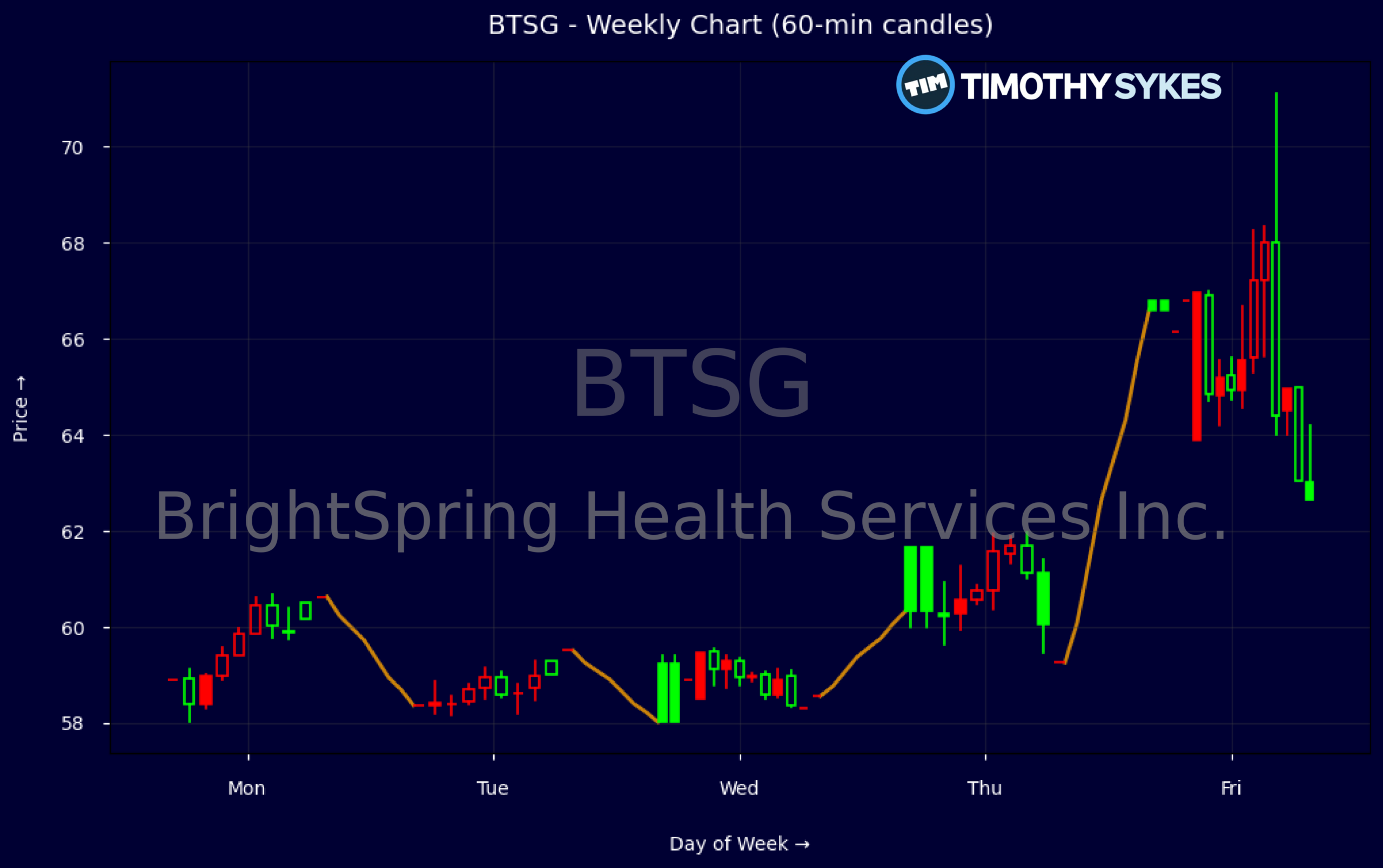
Weekly Update Oct 26 – Oct 30, 2026: On Saturday, October 31, 2026 BrightSpring Health Services Inc. stock [NASDAQ: BTSG] is trending up by 10.92%! Discover the key drivers behind this movement as well as our expert analysis in the detailed breakdown below.
Healthcare industry expert:
Analyst sentiment – positive
BrightSpring (BTSG) is emerging as a scaled provider in home- and community‑based care and pharmacy services, but its fundamentals still look early‑cycle public company rather than mature compounder. Q3 revenue annualizes near the $16B guidance, confirming rapid growth, yet margins remain thin: EBIT margin ~2.5%, EBITDA margin 3.7%, and gross margin 12.4%. Valuation is demanding at ~0.9x sales and ~39x EPS with a very high ~72x cash‑flow multiple, despite leverage of 1.8–2.9x and meaningful goodwill intensity.
Technically, the stock has broken sharply higher, moving from ~58 to ~67 in a week, with a strong expansion day on 10/30 (gap‑up and close near the high), confirming a short‑term bullish trend. Intraday 5‑minute candles show persistent buying on elevated volume, not just a one‑print spike, suggesting real accumulation. First actionable level is support near $60–61, the prior breakout zone and VWAP area from the gap day; risk‑defined long entries above $61 with stops around $58 look justified while momentum persists.
Fundamentally, Q3 delivered 26% revenue growth, 42% adjusted EBITDA growth, and a near tripling in continuing net income, plus raised 2026 revenue and EBITDA guidance above Street, driven by Amedisys/LHC consolidation and strong core execution. This growth and deleveraging trajectory screens better than the broader Healthcare and Providers & Services groups, albeit with structurally lower margins and higher valuation. I see continued re‑rating potential, with near‑term resistance around $70 and a 6‑12 month upside target of $78.
More Breaking News
Quick Financial Overview
BrightSpring Health Services Inc. just printed the kind of quarter that typically attracts momentum. Q3 2026 revenue reached $4.21B versus roughly $3.88B expected, a 26% year-over-year gain backed by Pharmacy and Provider strength. Adjusted EBITDA grew 42%, with net income from continuing operations nearly tripling and profit margin from continuing operations at 1.73%. For a business doing roughly $12.9B in trailing revenue, that kind of earnings acceleration matters.
On valuation, BTSG trades at a price-to-sales ratio of 0.88 and a P/E of 38.63. Margins are still thin, with EBIT margin at 2.5% and EBITDA margin at 3.7%, but they are moving in the right direction. Return on equity above 19% on an LTM basis and an asset turnover of 2.4 show the company is squeezing solid efficiency out of its asset base. With enterprise value around $14.90B, the market is clearly starting to price in sustained growth and improving profitability.
The balance sheet is better than many high-growth healthcare names. Total debt-to-equity is 1.17 with leverage at 2.9, while current and quick ratios of 1.6 and 1.1 suggest near-term liquidity is manageable. Q3 operating cash flow of about $204.3M and free cash flow of $182.2M back up the story of “robust cash generation” from management. Leverage reduction to 1.79x, plus $717.8M in cash, gives BrightSpring Health Services Inc. room to keep integrating Amedisys and LHC and possibly pursue more targeted deals.
On the tape, BTSG is acting like a classic earnings-breakout name. The weekly data show the stock grinding from the high-$50s to a close near $66.80 by 2026/10/30, with a big expansion bar on the last day of the week. Intraday, the 5-minute snapshot shows a surge from an open around $65.29 to a spike near $71.12 before settling back around $66.89. That pattern tells you there was aggressive buying on the news, followed by some profit taking but with bulls still in control into the close.
Conclusion
This is stock news, not investment advice. Timothy Sykes News delivers real-time stock market news focused on key catalysts driving short-term price movements. Our content is tailored for active traders and investors seeking to capitalize on rapid price fluctuations, particularly in volatile sectors like penny stocks. Readers come to us for detailed coverage on earnings reports, mergers, FDA approvals, new contracts, and unusual trading volumes that can trigger significant short-term price action. Some users utilize our news to explain sudden stock movements, while others rely on it for diligent research into potential investment opportunities.
Dive deeper into the world of trading with Timothy Sykes, renowned for his expertise in penny stocks. Explore his top picks and discover the strategies that have propelled him to success with these articles:
- Penny Stocks Trading Guide
- Best Penny Stocks Under $1 to Buy Today
- Top 8 Penny Stocks to Watch on Robinhood
Once you’ve got some stocks on watch, elevate your trading game with StocksToTrade the ultimate platform for traders. With specialized tools for swing and day trading, StocksToTrade will guide you through the market’s twists and turns.
Dig into StocksToTrade’s watchlists here:





Leave a reply