

Bentley Systems Incorporated stocks have been trading up by 8.18 percent following upbeat growth outlook and strong software demand.
Key Takeaways
- Seequent, Bentley Systems’ subsurface arm, is acquiring seismic specialist Eliis to plug its PaleoScan technology into a broader geophysics and energy modeling stack.
- The Eliis deal positions Bentley Systems and BSY to chase rising subsurface demand across energy, mining, groundwater, and carbon storage markets tied to the energy transition.
- Bank of America raised its BSY price target from $40 to $45 with a Buy rating, flagging the name as a preferred application software pick ahead of Q3 earnings.
- Baird also lifted its BSY target to $45 and reaffirmed an Outperform rating after updating its model before the upcoming Q3 print.
- Bentley Systems is spotlighting its Cesium platform powering TruGolf’s E6 simulation engine, underscoring BSY’s reach into fast-growing, high-fidelity 3D experiences.
Live Update At 11:32:46 EST: On Thursday, November 05, 2026 Bentley Systems Incorporated stock [NASDAQ: BSY] is trending up by 8.18%! Discover the key drivers behind this movement as well as our expert analysis in the detailed breakdown below.
Quick Financial Overview
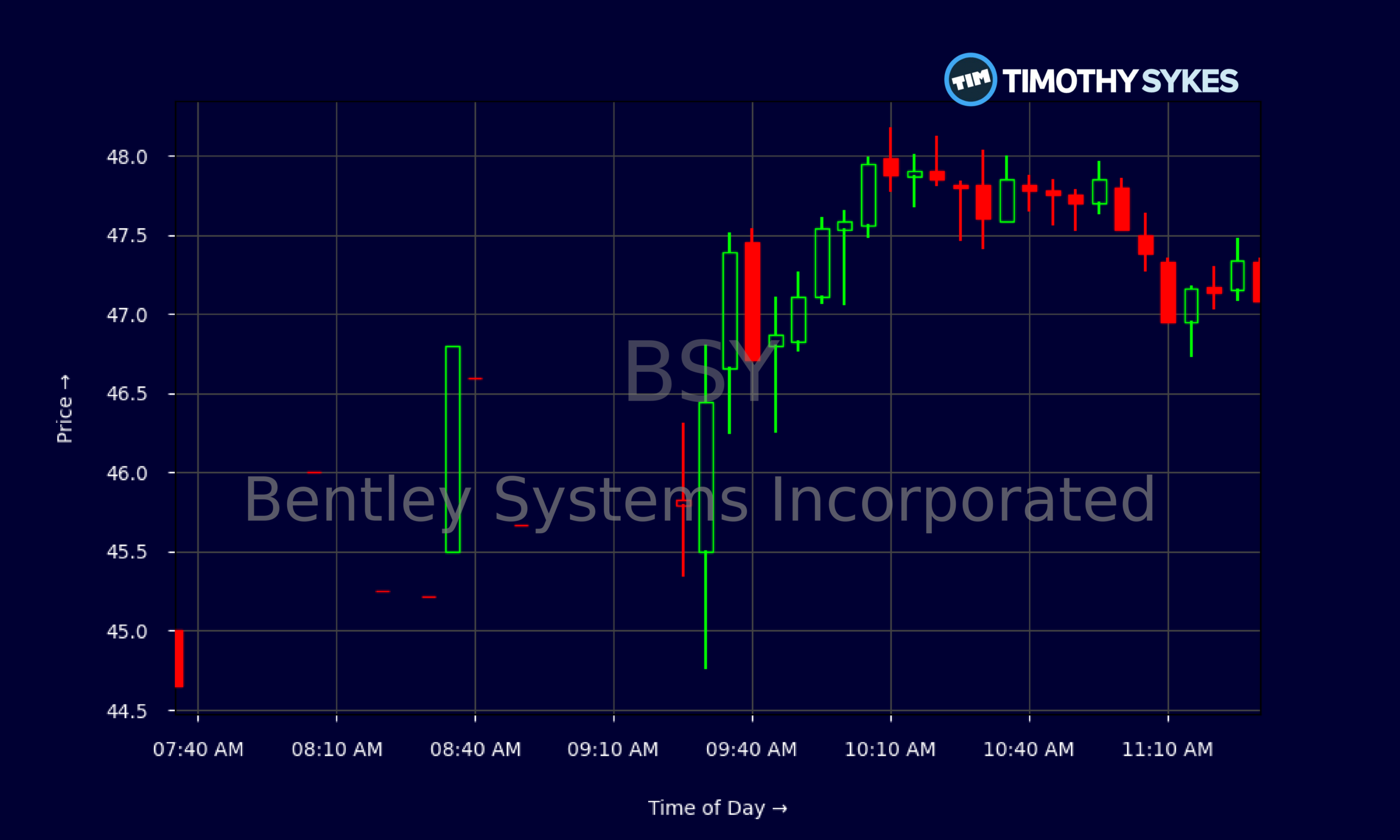
BSY has been in a steady grind higher that turned into a sharp breakout. From 2026/10/12 to 2026/11/04, Bentley Systems climbed from roughly $35 to $43.64. On 2026/11/05, BSY ripped again, opening near $45.48 and closing at $47.08 after tagging an intraday high of $48.17. That is a strong multi-week uptrend with an acceleration into the latest news.
Intraday, BSY’s 5‑minute chart shows classic momentum action. After an early spike from the $45s into the mid‑$46s at the open, buyers quickly pushed BSY into the $47–$48 zone and then defended that range. Dips toward $47 kept getting bought, showing real demand and tight intraday consolidation rather than a blow‑off top.
More Breaking News
Under the hood, Bentley Systems is not a junk momentum story. BSY posted about $1.50B in annual revenue with double‑digit growth over three and five years. Gross margin near 82% and EBIT margin around 25% point to a high‑quality software model. Returns on equity above 24% back that up. The trade‑off is valuation: a P/E near 39 and price‑to‑sales around 6.6 keep BSY firmly in premium territory, where execution and guidance matter every quarter.
Why Traders Are Watching BSY Right Now
Traders are crowding into BSY because the news flow lines up almost perfectly with the chart. Bentley Systems just confirmed that its subsurface unit Seequent is acquiring Eliis, a specialist in seismic interpretation software best known for its PaleoScan platform. For a company already strong in infrastructure and geospatial tools, plugging in Eliis gives Bentley Systems deeper coverage across geophysics, energy, and subsurface modeling.
That matters because subsurface data is central to some of the market’s biggest themes. Through Seequent and Eliis, BSY is targeting work across energy, mining, groundwater, and carbon storage. Those are long‑cycle, regulated industries where software vendors tend to be sticky once embedded. For momentum‑focused traders, an acquisition that extends BSY’s reach into energy transition and resource management workflows can support the idea of higher future earnings and, with it, a sustained uptrend.
Wall Street is noticing. Bank of America raised its BSY price target from $40 to $45 and reiterated a Buy, explicitly calling Bentley Systems a preferred application software name in a market where AI and data‑heavy workflows are separating leaders from laggards. Baird followed up, nudging its target from $44 to $45 and reiterating Outperform ahead of BSY’s Q3 2026 results, due 2026/11/05.
Layer on top the story around Bentley Systems’ Cesium platform powering TruGolf’s E6 runtime course generation and streaming. That user case shows BSY’s tech handling high‑fidelity 3D simulation and streaming well beyond classic engineering. For traders, these pieces tell a single story: BSY is expanding its product scope, winning new‑school workloads, and walking into earnings with a bullish analyst backdrop and a chart already in breakout mode.
Conclusion
BSY is heading into its Q3 2026 webcast on 2026/11/05 with the wind at its back. Bentley Systems has a clear growth narrative: strong software economics, expanding subsurface capabilities through the Eliis acquisition, and credible proof that platforms like Cesium can power demanding simulation experiences such as TruGolf’s E6. The balance sheet shows leverage, but interest coverage near 20x and consistent free cash flow support the case that Bentley Systems can fund deals and still return cash via dividends.
For short‑term traders, the key now is how BSY trades around that earnings catalyst. The stock already rallied from the mid‑$30s into the high‑$40s while analysts from Bank of America, Baird, and others pulled targets up to around $45 and maintained overweight‑style ratings. That leaves less room for disappointment. Bentley Systems will need to back the hype with clean numbers and confident commentary on Eliis, subsurface demand, and ongoing AI‑driven workflows.
In the Tim Sykes world, this is where discipline matters. As Tim likes to hammer home, “The market rewards preparation, not hope — study the pattern, know your levels, and cut losses quickly when the trade proves you wrong.” As millionaire penny stock trader and teacher Tim Sykes says, “Consistency is key in trading; don’t let emotions dictate your trades.”. Applied to BSY, that means using the strong trend, high‑volume breakouts, and clear news catalysts as your map, not a guarantee. Bentley Systems and BSY are offering an intriguing educational case study in how narrative, numbers, and price action line up — but the trading plan is always on you.
This is stock news, not investment advice. Timothy Sykes News delivers real-time stock market news focused on key catalysts driving short-term price movements. Our content is tailored for active traders and investors seeking to capitalize on rapid price fluctuations, particularly in volatile sectors like penny stocks. Readers come to us for detailed coverage on earnings reports, mergers, FDA approvals, new contracts, and unusual trading volumes that can trigger significant short-term price action. Some users utilize our news to explain sudden stock movements, while others rely on it for diligent research into potential investment opportunities.
Dive deeper into the world of trading with Timothy Sykes, renowned for his expertise in penny stocks. Explore his top picks and discover the strategies that have propelled him to success with these articles:
- Penny Stocks Trading Guide
- Best Penny Stocks Under $1 to Buy Today
- Top 8 Penny Stocks to Watch on Robinhood
Once you’ve got some stocks on watch, elevate your trading game with StocksToTrade the ultimate platform for traders. With specialized tools for swing and day trading, StocksToTrade will guide you through the market’s twists and turns.
Dig into StocksToTrade’s watchlists here:





Leave a reply