

Axogen Inc. stocks have been trading up by 27.46 percent amid strong investor optimism on its latest clinical progress.
Key Takeaways Traders Should Watch
- Q2 2026 revenue climbed 23.1% to $69.7M, with Axogen raising full‑year guidance to at least $279M and targeting 73%+ gross margins and positive free cash flow.
- The BioCircuit Technologies acquisition adds NerveTape and is expected to contribute about $6M of Q4 2026 revenue and roughly $34M in 2027 without relying on it to hit 24%+ growth guidance.
- Bank of America started coverage on AXGN with a Buy and a $52 target, highlighting its full peripheral nerve repair product suite and high‑teens to ~20% medium‑term revenue growth outlook.
- Barclays launched AXGN at Overweight with a $55 target, later trimming to $50 but keeping the bullish stance, citing upside from BioCircuit and NerveTape integration.
- Truist lowered its AXGN target from $60 to $53 yet kept a Buy, pointing to dilution and sector multiple pressure while flagging strong surgeon feedback on Axogen’s nerve repair tape and a Street Buy consensus in the mid‑$50s.
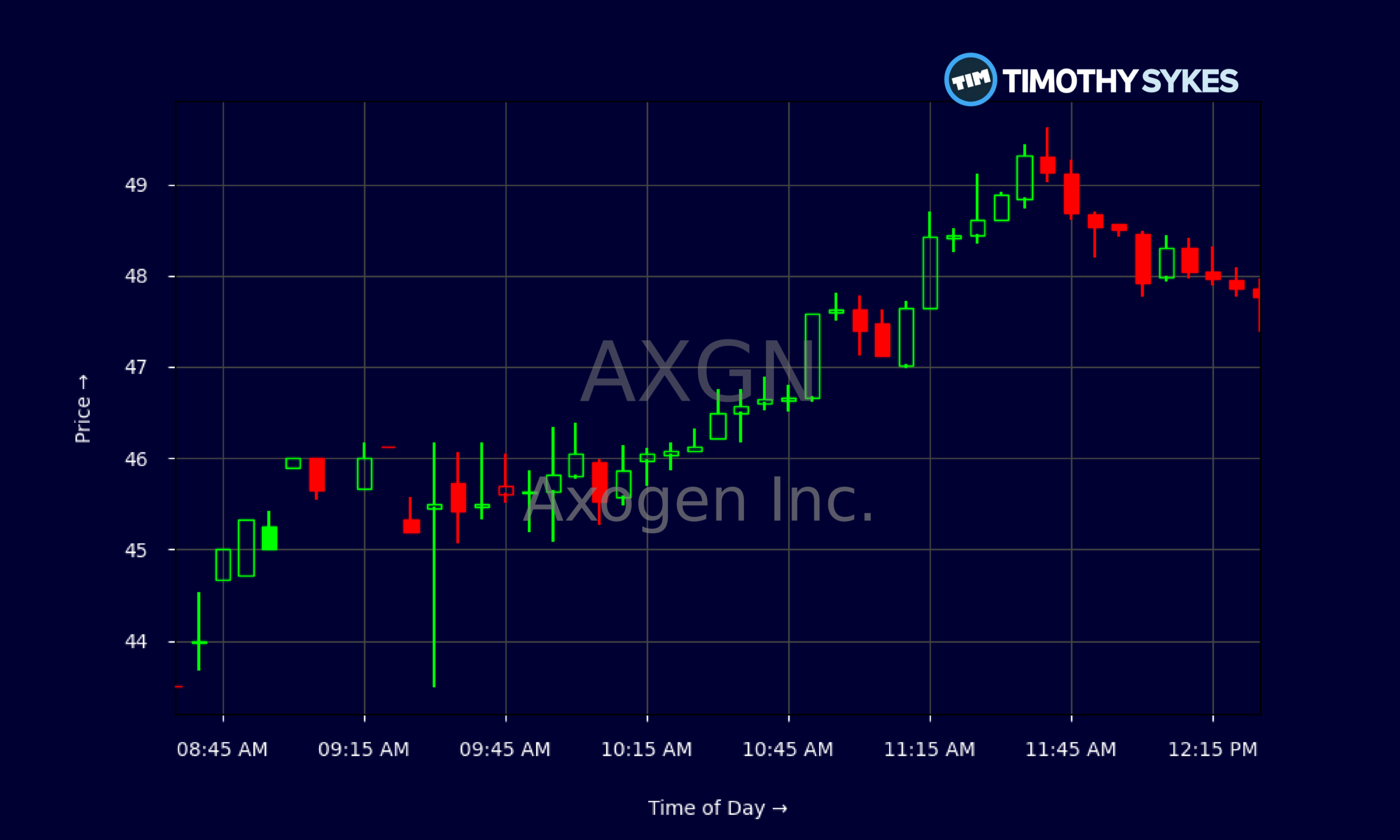
Live Update At 12:32:58 EDT: On Wednesday, October 28, 2026 Axogen Inc. stock [NASDAQ: AXGN] is trending up by 27.46%! Discover the key drivers behind this movement as well as our expert analysis in the detailed breakdown below.
Quick Financial Overview
AXGN has been trading like a momentum name with real numbers behind it. On 2026/10/28, the stock ripped from a $45.45 open to a $49.61 high and closed at $47.75. That move followed a steady grind higher from the mid‑$34s earlier in the month, showing a clear uptrend with higher lows from 2026/10/16 through 2026/10/27.
Intraday, AXGN’s 5‑minute chart shows strong dip buying. Early flushes toward $45 were snapped up, with volume pushing the stock into the high $48s and low $49s by late morning. For short‑term traders, that intraday pattern screams demand at every pullback and tight consolidation near the highs.
More Breaking News
Fundamentally, Axogen reported Q2 2026 revenue of $69.7M and 23.1% year‑over‑year growth, then raised full‑year guidance to at least $279M, or 24%+ growth. Gross margin sits around 74.6%, with management targeting at least 73% and positive free cash flow. AXGN is still losing money on the bottom line, but negative net margins near the mid‑teens are narrowing as scale kicks in. Low debt, a current ratio of 6.6, and free cash flow of about $5.47M point to a balance sheet that can support continued growth. For traders, that mix of fast revenue growth, improving cash generation, and strong price action creates a classic high‑beta setup.
Why Traders Are Watching AXGN Right Now
AXGN is suddenly in the middle of the action because the story lines are lining up with the chart. On the business side, Axogen just closed the BioCircuit Technologies acquisition, pulling in NerveTape, the first FDA‑cleared sutureless peripheral nerve repair device. Management expects roughly $6M of extra revenue in Q4 2026 and about $34M in 2027 from this deal, yet did not need that acquisition to maintain at least 24% 2026 revenue growth. That tells traders the core Axogen engine is already running hot, and NerveTape is layered on top as upside.
Wall Street is reacting. Lake Street reiterated a Buy on AXGN after the BioCircuit deal and explicitly framed recent weakness as an opportunity to accumulate, leaning on expectations for core business strength, NerveTape uptake, and new commercial wins to drive outperformance and multiple expansion. That “buy the dip” stance has been echoed indirectly by others.
Bank of America stepped in with a Buy and a $52 target, calling Axogen the only company offering a full peripheral nerve repair product suite and projecting high‑teens to roughly 20% revenue growth over the medium term. Barclays launched coverage Overweight with a $55 target as part of a broader medical devices rollout, seeing the sector as beaten‑down and due for stabilization by 2027. Even after Barclays trimmed its AXGN target to $50, the firm doubled down on the idea that BioCircuit and NerveTape integration could push numbers above current Street expectations.
Truist shaved its target from $60 to $53 on dilution and sector multiple compression, but kept a Buy and highlighted positive surgeon feedback on Axogen’s nerve repair tape. Across banks, AXGN carries a Buy consensus with average targets in the low‑to‑mid $50s, above recent trading levels. Add in a Schedule 13G showing a new significant, but passive, holder in Axogen, and you have a tape where institutions appear to be quietly building exposure while traders ride the volatility.
Conclusion
For active traders, AXGN is one of those names where the story, the Street, and the chart all point in the same direction, at least for now. Axogen is putting up 20%+ top‑line growth, guiding to 73%+ gross margins, and generating positive free cash flow, while still posting GAAP losses that keep the skeptics nervous. That tension is exactly what fuels big moves when expectations reset.
The BioCircuit Technologies acquisition and NerveTape give AXGN a fresh narrative leg, but management’s choice not to lean on the deal to boost 2026 guidance stands out. It suggests confidence in Axogen’s existing portfolio, including the high‑growth Breast segment, with the acquired assets acting as an extra catalyst rather than a crutch. With Bank of America, Barclays, Truist, and Lake Street all sitting in the Buy/Overweight camp, price targets cluster around the low‑to‑mid $50s, leaving room above the recent $40s handle if Axogen keeps executing.
The next big checkpoint is the Q3 2026 earnings release and call on 2026/10/28, where traders will look for updates on NerveTape traction, Breast segment momentum, and any tweaks to guidance. In the words of Tim Sykes, “The best traders don’t predict, they prepare — they map out every scenario before the market opens.” As millionaire penny stock trader and teacher Tim Sykes, says, “There is always another play around the corner; don’t chase just because you feel FOMO.”. For AXGN, that means knowing your levels, tracking the news flow, and being ready to cut losses fast if the story breaks, or press the trade if the numbers back up the hype.
This is stock news, not investment advice. Timothy Sykes News delivers real-time stock market news focused on key catalysts driving short-term price movements. Our content is tailored for active traders and investors seeking to capitalize on rapid price fluctuations, particularly in volatile sectors like penny stocks. Readers come to us for detailed coverage on earnings reports, mergers, FDA approvals, new contracts, and unusual trading volumes that can trigger significant short-term price action. Some users utilize our news to explain sudden stock movements, while others rely on it for diligent research into potential investment opportunities.
Dive deeper into the world of trading with Timothy Sykes, renowned for his expertise in penny stocks. Explore his top picks and discover the strategies that have propelled him to success with these articles:
- Penny Stocks Trading Guide
- Best Penny Stocks Under $1 to Buy Today
- Top 8 Penny Stocks to Watch on Robinhood
Once you’ve got some stocks on watch, elevate your trading game with StocksToTrade the ultimate platform for traders. With specialized tools for swing and day trading, StocksToTrade will guide you through the market’s twists and turns.
Dig into StocksToTrade’s watchlists here:





Leave a reply