

Ring Energy Inc. stocks have been trading up by 7.5 percent following upbeat analyst coverage and stronger-than-expected production metrics.
What Traders Need To Know
- Ring Energy announced the scheduled dates and logistics for releasing its Q3 2026 earnings.
- The company will host a conference call in conjunction with its Q3 2026 earnings release.
- Management reiterated its continued focus on oil and gas development in the Permian Basin.
- Recent price action shows a push from the low $1.30s into the mid $1.40s on the week.
- Intraday strength toward $1.43 highlights short-term buying interest ahead of the earnings event.
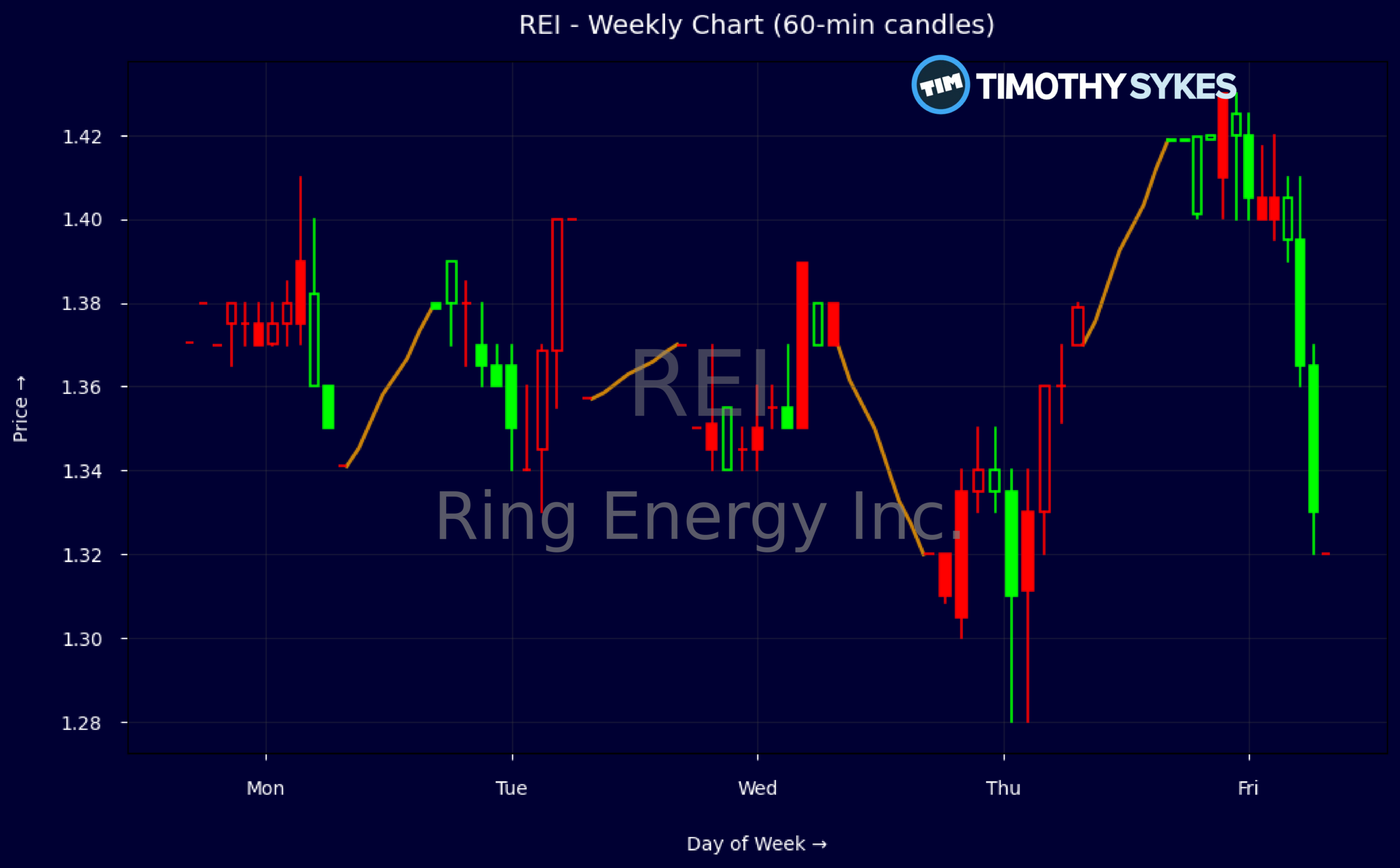
Weekly Update Oct 19 – Oct 23, 2026: On Sunday, October 25, 2026 Ring Energy Inc. stock [NYSE American: REI] is trending up by 7.5%! Discover the key drivers behind this movement as well as our expert analysis in the detailed breakdown below.
Energy industry expert:
Analyst sentiment – neutral
Ring Energy (REI) sits in a challenged but asset-backed position in the small-cap E&P space. Revenue of ~$307M with a strong 55% gross margin contrasts with deeply negative EBIT margin (-64%) and profit margin (-68%), reflecting heavy depletion, DD&A and one-offs. Valuation is undemanding at ~1.0x sales and 0.45x book, with EV near $735M. Leverage is moderate (debt-to-equity 0.48), but liquidity is tight: current ratio 0.5 and working capital of about -$52M.
The latest quarter shows operational strength but capital-intensity risk. REI delivered $105M+ annualized revenue run-rate, $50M operating income and $65M net income, yet free cash flow was slightly negative (~$0.75M) due to $41M capex and reliance on equity issuance to manage a $360M revolver. Weekly prices from 1.37 to 1.42 show a short-term uptrend, with support around 1.32 and resistance near 1.43. Above-average intraday volume near 1.40–1.42 signals aggressive short-term buying.
The scheduled Q3 2026 earnings release and call are the next key catalyst, with investor focus on Permian drilling returns, capex discipline and debt trajectory versus Energy and Fossil Fuels peers that now prioritize free cash flow. REI screens cheaper than most E&P benchmarks on price-to-book and cash flow, but weaker on returns and balance-sheet flexibility. Base case is a trading range with upside toward $1.60 if Q3 confirms sustained FCF and leverage stability; support holds at $1.30; strong resistance $1.70.
More Breaking News
Quick Financial Overview
Ring Energy Inc. (REI) just laid out the timing for its Q3 2026 earnings release and conference call, giving traders a clear catalyst date to watch. The stock’s weekly chart shows a move from roughly $1.32 to around $1.42 by the latest close, which is a solid climb within a tight range. Intraday, REI traded between roughly $1.32 and $1.43 and finished near the high, signaling short-term momentum buyers are stepping in ahead of new information.
On the fundamental side, Ring Energy Inc. generated about $307.2M in revenue, with strong gross margin near 55.1%, but overall profit margins are weak and skew negative on a trailing basis. That tells traders the core operations can produce value, yet heavy costs, charges, or one-off items are weighing on the bottom line. Key ratios like price-to-sales near 1.05 and price-to-book around 0.45 point to a market that still discounts the equity versus its asset base.
The balance sheet shows total assets around $1.28B and long-term debt of about $360.0M, with total debt-to-equity at 0.48 and a current ratio near 0.5. Liquidity is tight, and working capital is negative, so short-term obligations matter. At the same time, Ring Energy Inc. is throwing off positive operating cash flow, around $40.8M in the latest quarter, while free cash flow was slightly negative after heavy capital spending. For traders, that mix of discounted valuation, operational cash generation, and leverage sets the stage for earnings to either confirm stability or reignite concern.
Conclusion
This is stock news, not investment advice. Timothy Sykes News delivers real-time stock market news focused on key catalysts driving short-term price movements. Our content is tailored for active traders and investors seeking to capitalize on rapid price fluctuations, particularly in volatile sectors like penny stocks. Readers come to us for detailed coverage on earnings reports, mergers, FDA approvals, new contracts, and unusual trading volumes that can trigger significant short-term price action. Some users utilize our news to explain sudden stock movements, while others rely on it for diligent research into potential investment opportunities.
Dive deeper into the world of trading with Timothy Sykes, renowned for his expertise in penny stocks. Explore his top picks and discover the strategies that have propelled him to success with these articles:
- Penny Stocks Trading Guide
- Best Penny Stocks Under $1 to Buy Today
- Top 8 Penny Stocks to Watch on Robinhood
Once you’ve got some stocks on watch, elevate your trading game with StocksToTrade the ultimate platform for traders. With specialized tools for swing and day trading, StocksToTrade will guide you through the market’s twists and turns.
Dig into StocksToTrade’s watchlists here:





Leave a reply