

Maplebear Inc. stocks have been trading up by 9.22 percent after upbeat consumer demand headlines fueled stronger growth expectations.
What Traders Need To Know
- Reported sale talks have Maplebear Inc. working with bankers and speaking with DoorDash and Uber, with a possible $16–17B valuation implying a 30%–40% takeover premium.
- Shares of CART surged roughly 7%–9% to around $55.98 after sale headlines, marking a sharp repricing of deal odds.
- Wells Fargo lifted its CART price target to $56, citing improving Q3/Q4 order trends and benefits from partnerships like Gopuff and smaller-basket initiatives.
- A FoodStorm-powered partnership with Big Y adds in‑store kiosks, online catering, and Instacart delivery across 79 stores, with the stock up about 2.4% on the rollout.
- A $5M DOJ/EEOC settlement over discrimination claims adds regulatory risk, even if the direct financial impact is limited.
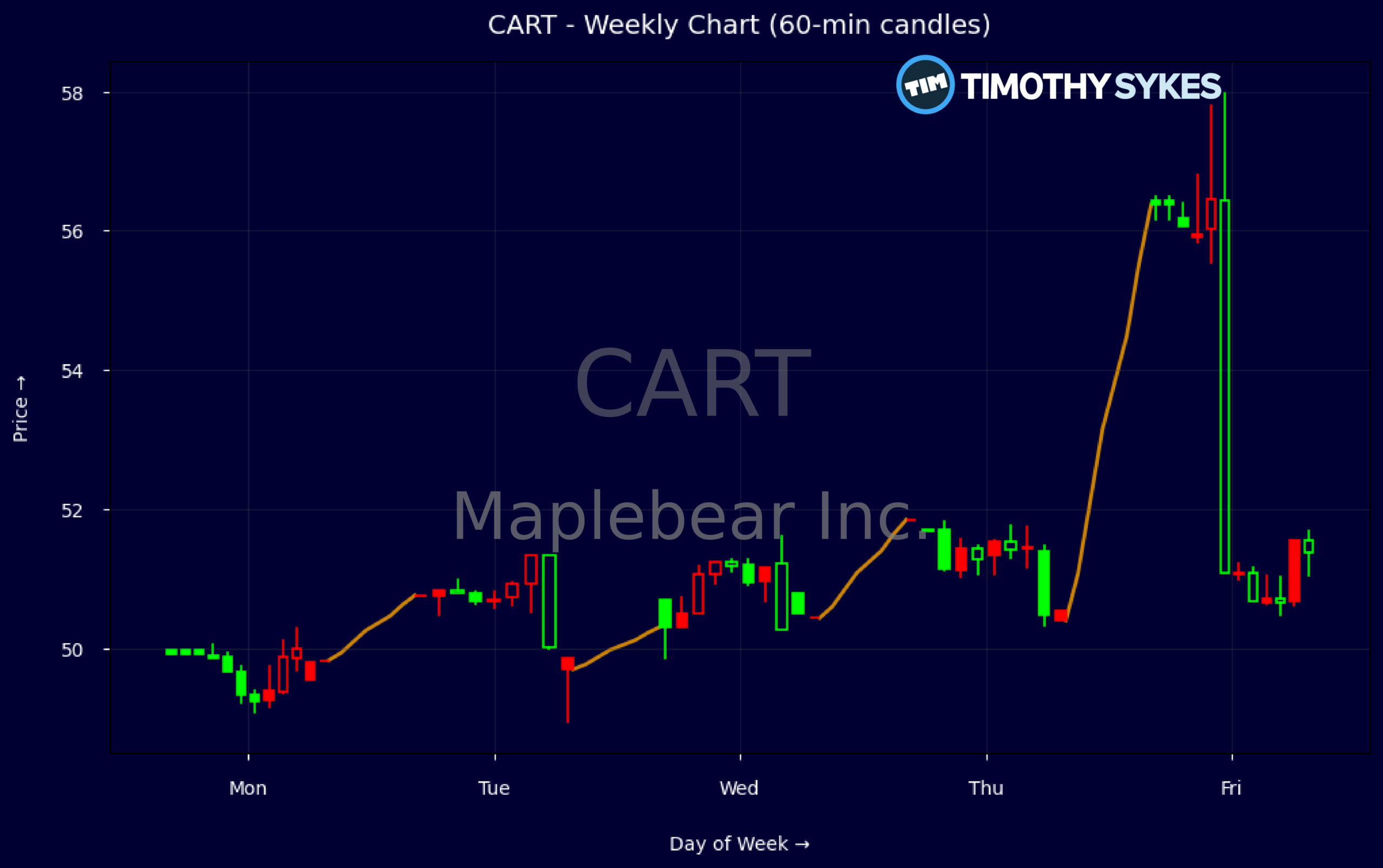
Weekly Update Oct 19 – Oct 23, 2026: On Saturday, October 24, 2026 Maplebear Inc. stock [NASDAQ: CART] is trending up by 9.22%! Discover the key drivers behind this movement as well as our expert analysis in the detailed breakdown below.
Consumer Discretionary industry expert:
Analyst sentiment – positive
Instacart (CART) now operates from a position of clear profitability and balance-sheet strength within Consumer Discretionary. Gross margin of 72.6% and EBIT margin of 13% on $3.74B revenue underscore a highly scalable, asset-light model, while pre-tax margin above 26% reflects sizable non-operating income leverage. ROIC around 14% and LTM ROE near 17% compare favorably to online retail peers. Virtually no leverage (D/E ~0.01, current ratio 2.3) plus $481M quarterly FCF and ongoing buybacks support sustained capital returns.
Technically, CART is in a powerful short-term uptrend. The weekly tape shows a decisive breakout from the high‑40s to mid‑50s, with the latest bar closing near the high at 56.45 after a series of higher highs and higher lows. Five‑minute action confirms strong upside momentum with elevated breakout volume on the sale headlines. First actionable level is $55–56, now key support; above it, dips are buyable, while a close below $55 would signal a failed breakout.
Near term, the dominant catalyst is the reported strategic sale exploration with Uber and DoorDash at a potential $16–17B valuation, implying roughly a 30–40% premium to prior levels and creating a clear event-driven floor under the stock. Added upside comes from FoodStorm expansion and upward estimate revisions vs. a still-cautious Equal Weight stance. CART should outperform Retail – Discretionary into the November 5 print; risk‑reward is attractive up to the low‑60s, with support $55 and resistance $62–64.
More Breaking News
Quick Financial Overview
CART’s tape is telling you this is now a catalyst-driven name. On the weekly data, the stock pushed from the low $50s and spiked to a 57.79 high on 2026/10/23, closing at 56.45. That closing level sits just under the reported $55.98 pop level and lines up almost exactly with the Wells Fargo target at $56, showing how quickly price has gravitated to both analyst and rumor reference points.
Intraday, the 5‑minute candle shows a wide range from about 50.49 to 57.98 before settling near 56.44. For short‑term traders, that kind of intraday spread signals aggressive chasing and forced covering once the Instacart sale headlines hit. Maplebear Inc. is now trading as a potential deal proxy rather than a slow grinder; volatility is the message, and risk controls need to match that.
Under the hood, CART is not a weak story. Revenue sits around $3.742B with strong 3‑year growth near 39%, backed by a hefty 72.6% gross margin and double‑digit EBIT margin. A forward P/E near 25.96 and price‑to‑sales around 2.84 are not dirt cheap, but a price‑to‑free‑cash multiple under 6x and operating cash flow of $494M against free cash flow of $481M show real cash generation. The balance sheet is light on leverage, with total debt‑to‑equity near 0.01 and a current ratio of 2.3, important if a sale does not materialize and CART trades back on fundamentals.
Conclusion
This is stock news, not investment advice. Timothy Sykes News delivers real-time stock market news focused on key catalysts driving short-term price movements. Our content is tailored for active traders and investors seeking to capitalize on rapid price fluctuations, particularly in volatile sectors like penny stocks. Readers come to us for detailed coverage on earnings reports, mergers, FDA approvals, new contracts, and unusual trading volumes that can trigger significant short-term price action. Some users utilize our news to explain sudden stock movements, while others rely on it for diligent research into potential investment opportunities.
Dive deeper into the world of trading with Timothy Sykes, renowned for his expertise in penny stocks. Explore his top picks and discover the strategies that have propelled him to success with these articles:
- Penny Stocks Trading Guide
- Best Penny Stocks Under $1 to Buy Today
- Top 8 Penny Stocks to Watch on Robinhood
Once you’ve got some stocks on watch, elevate your trading game with StocksToTrade the ultimate platform for traders. With specialized tools for swing and day trading, StocksToTrade will guide you through the market’s twists and turns.
Dig into StocksToTrade’s watchlists here:





Leave a reply