
Elong Power Holding Limited stocks have been trading up by 34.02 percent following bullish sentiment from strong renewable energy expansion news.
Key Takeaways For ELPW Traders
- Price action in ELPW shows a steady grind off recent lows, with multi-day closes holding above $2.25.
- Intraday trading ranges around $3.00–$3.80 highlight elevated volatility that short-term traders often seek.
- Financials show Elong Power Holding Limited with roughly $7.6M in cash and heavy liabilities, creating a classic high-risk setup.
- Negative equity and thin revenue base keep ELPW firmly in the speculative, story-driven category for trading.
Live Update At 09:19:31 EDT: On Wednesday, October 28, 2026 Elong Power Holding Limited stock [NASDAQ: ELPW] is trending up by 34.02%! Discover the key drivers behind this movement as well as our expert analysis in the detailed breakdown below.
Quick Financial Overview
ELPW is trading like a small, speculative power play, and the numbers back that up. On the income side, Elong Power Holding Limited reported roughly $2.05M in revenue, a tiny base for a listed company. With a price-to-sales ratio near 1.23, the market is not paying a rich premium, but it is still valuing a thin revenue stream.
The balance sheet is where things get loud. ELPW carries about $27.7M in total assets, but total liabilities sit near $50.5M. Common stock equity is deeply negative at about -$22.7M, driven by retained earnings around -$74.5M. That’s why book value per share is roughly -$24.40 and the price-to-book ratio is negative.
More Breaking News
Cash and short-term investments total about $7.6M, while current debt runs close to $18.9M and long-term debt adds another $24.6M. For traders, that means Elong Power Holding Limited is financially stretched, but still alive. This combination of low revenue, heavy debt, and negative equity often turns ELPW into a pure price-action and sentiment trade rather than a fundamentals story.
Why Traders Are Watching ELPW Price Action
ELPW has been a classic grinder on the daily chart. Over the last couple of weeks, Elong Power Holding Limited has moved from opens around $2.28–$2.30 to recent closes near $2.44. The stock is not exploding, but it’s holding higher lows after dipping into the low $2.20s. For short-term traders, that slow staircase pattern often signals accumulation, or at least a tug-of-war where buyers are no longer getting steamrolled.
Look closer at the daily candles. The range from about $2.21 on the downside to roughly $2.84 on the upside shows ELPW can move when volume shows up. Multiple sessions closed near $2.44–$2.55, suggesting that area has become a key battleground level on the swing time frame.
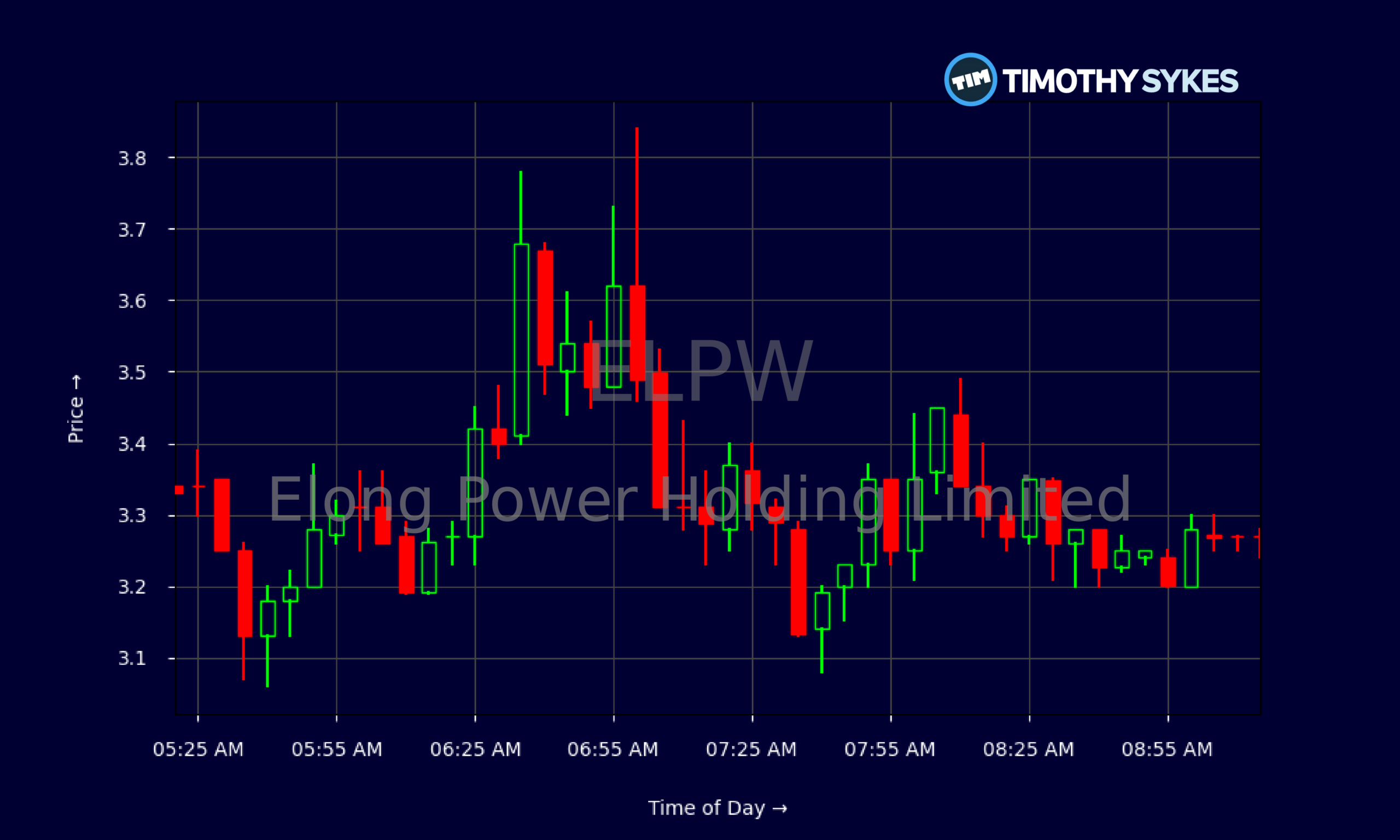
Now zoom into the intraday 5‑minute action. ELPW spiked from the mid‑$2.50s at 04:00 up into the $3.60–$3.80 zone within a couple of hours, then churned between $3.20 and $3.50. That’s a big percent move in a tight window. Elong Power Holding Limited then cooled off, trading a tighter band around $3.20–$3.30 into the 09:00 hour.
For active day traders, that sequence matters. ELPW showed an early morning spike, a pullback, and then consolidation near the middle of the move. That’s the classic framework for dip-buy setups, breakout retries, and tight risk management. When a small-cap like Elong Power Holding Limited proves it can swing nearly a dollar intraday, traders pay attention.
Conclusion
ELPW sits right in the wheelhouse of speculative small-cap trading: volatile chart, weak fundamentals, and the potential for fast moves both ways. Elong Power Holding Limited’s negative equity, heavy debt load, and modest $2.05M revenue base make it risky from a long-term balance-sheet view, but that same pressure often fuels sharp squeezes when shorts get crowded or volume floods in.
On the daily chart, ELPW is holding above $2.20 and grinding toward the mid‑$2 range, while intraday candles show strong spikes through $3.50 and quick reversals. That tells traders to respect both sides of the tape. Elong Power Holding Limited can reward precise entries, but it punishes hesitation and oversized positions.
For those studying ELPW, the key is strict discipline: map your levels around prior highs near $2.80–$2.90 and the recent intraday bands between $3.20 and $3.80, then size according to the volatility. As Tim Sykes likes to say, “Discipline and risk management are the only things you can truly control in the market.” As millionaire penny stock trader and teacher Tim Sykes, says, “Preparation plus patience leads to big profits.”. Use that mindset when planning any trade in ELPW, because this name is all about speed, preparation, and cutting losses fast.
This is stock news, not investment advice. Timothy Sykes News delivers real-time stock market news focused on key catalysts driving short-term price movements. Our content is tailored for active traders and investors seeking to capitalize on rapid price fluctuations, particularly in volatile sectors like penny stocks. Readers come to us for detailed coverage on earnings reports, mergers, FDA approvals, new contracts, and unusual trading volumes that can trigger significant short-term price action. Some users utilize our news to explain sudden stock movements, while others rely on it for diligent research into potential investment opportunities.
Dive deeper into the world of trading with Timothy Sykes, renowned for his expertise in penny stocks. Explore his top picks and discover the strategies that have propelled him to success with these articles:
- Penny Stocks Trading Guide
- Best Penny Stocks Under $1 to Buy Today
- Top 8 Penny Stocks to Watch on Robinhood
Once you’ve got some stocks on watch, elevate your trading game with StocksToTrade the ultimate platform for traders. With specialized tools for swing and day trading, StocksToTrade will guide you through the market’s twists and turns.
Dig into StocksToTrade’s watchlists here:





Leave a reply