

Bolt Biotherapeutics Inc. stocks have been trading up by 63.72 percent following highly positive trial and pipeline progress news
Market Insights For Active BOLT Traders
- Reverse merger refocuses the company around Prana’s INSPIRE platform, led by PRA-216, a Phase 2 IL-4Rα/TSLP bispecific antibody in major inflammatory diseases.
- A $120M upfront private placement, plus up to $60M in potential warrant proceeds, is expected to fund operations into 2028 and multiple clinical milestones.
- The Prana acquisition and financing drove a sharp 62% surge in the stock on very heavy volume, flagging strong interest from momentum traders.
- Legacy holders are heavily diluted but now own a better-funded inflammatory disease platform with multiple mid- to late-2020s data catalysts and a new leadership role for Prana’s co-founder.
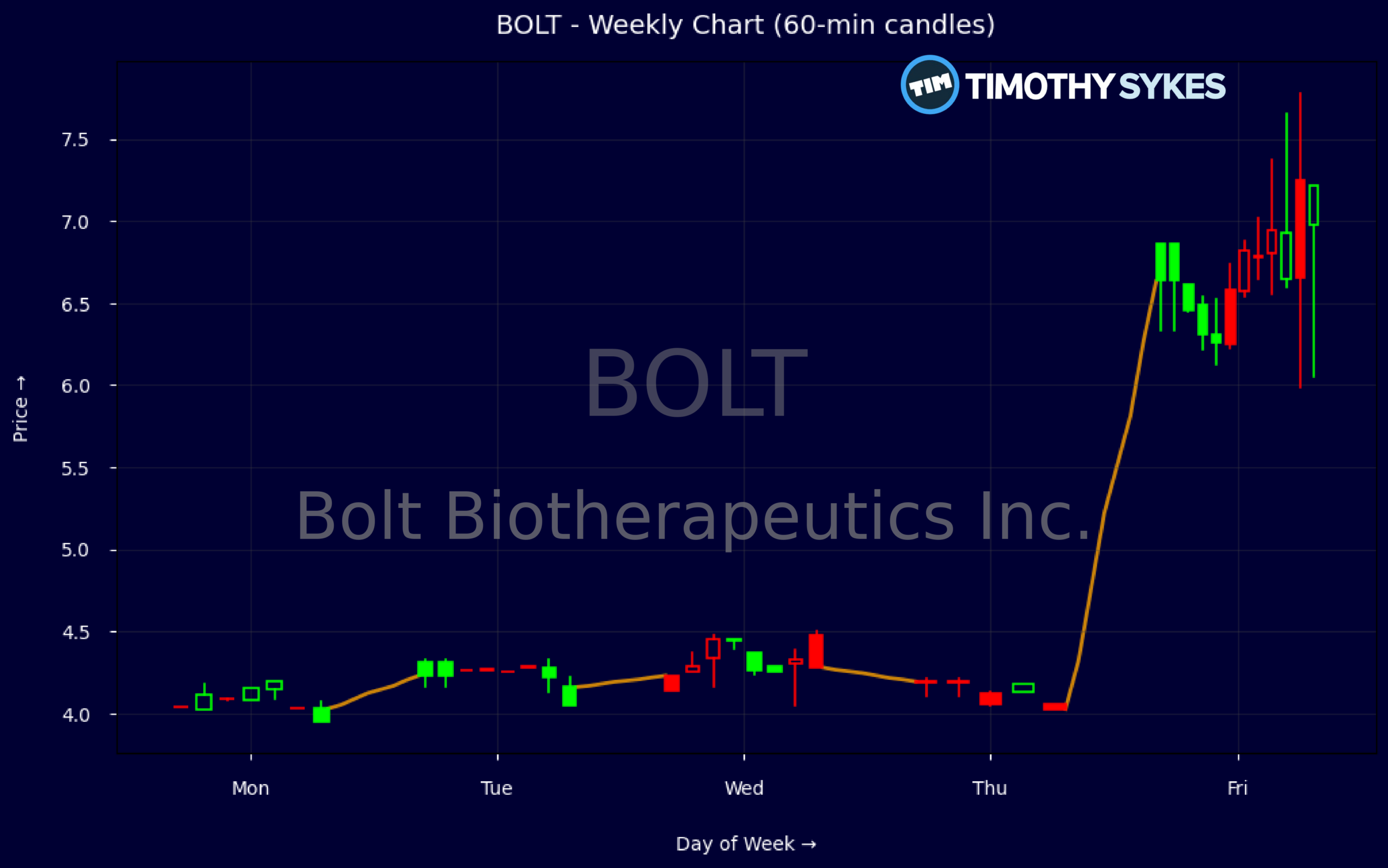
Weekly Update Oct 19 – Oct 23, 2026: On Sunday, October 25, 2026 Bolt Biotherapeutics Inc. stock [NASDAQ: BOLT] is trending up by 63.72%! Discover the key drivers behind this movement as well as our expert analysis in the detailed breakdown below.
Healthcare industry expert:
Analyst sentiment – positive
Bolt Biotherapeutics (BOLT) remains a deeply unprofitable small-cap biotech, effectively pre-revenue with just $5k quarterly revenue and EBITDA margin near -560%. Returns on capital and equity are severely negative (ROIC ~-50%, ROE ~-65%), and free cash flow for the quarter was roughly -$6.6M, underscoring a cash-burning clinical platform. Nevertheless, liquidity is solid near term: current ratio 2.6, $17.6M cash and equivalents, and modest equity value versus invested capital (P/B ~0.6).
Technically, the stock transitioned from a tight consolidation around $4.00–4.30 to a sharp breakout, closing the latest week at $6.86 on a gap and strong upside follow-through, consistent with very heavy volume around the Prana transaction. The dominant trend is now short-term bullish with momentum buyers in control. The key actionable level is $6.00: above it, longs can trade against that support; a sustained break back below $5.50 would invalidate the breakout.
The Prana reverse merger and $120M private placement (plus up to $60M warrants) radically improve BOLT’s risk profile versus typical micro-cap biotech peers by extending runway into 2028 and upgrading to a Phase 2 inflammatory pipeline centered on PRA-216. Relative to healthcare and biotech benchmarks, BOLT now carries higher clinical risk but also higher upside optionality. Near term, expect elevated volatility; fair trading band is $5.50–$8.50, with initial resistance near $7.50 and a 6–12 month upside target of $9.
More Breaking News
Quick Financial Overview
Bolt Biotherapeutics Inc. just shifted its story in a single move. The reverse merger with Prana Therapies brings in the INSPIRE platform and PRA-216, a Phase 2 bispecific antibody targeting IL-4Rα and TSLP across asthma, COPD, atopic dermatitis, and future EoE trials. For traders, that means BOLT now trades more like an inflammatory disease pipeline play than its legacy profile, with a clearer, later-stage lead asset and defined data milestones in the coming years.
On the tape, the reaction was strong. Weekly data show BOLT grinding in the low-$4 range before spiking from roughly $4.19 to $6.86, a breakout move that lines up with the reported 62% jump on news and financing. Intraday, a wide 5‑minute candle between about $6 and almost $7.80 shows aggressive buying followed by fast profit-taking, a classic high-volatility news reaction that day traders should respect.
Under the hood, the legacy Bolt Biotherapeutics Inc. financials show a typical clinical-stage biotech profile: only about $7.70M in revenue and very steep negative margins, with return on equity deeply negative and free cash flow at roughly -$6.55M for the recent quarter. Cash and short-term investments near $17.60M pre-deal, combined with the new $120M raise and warrant potential, point to a far longer runway and reduced near-term financing risk. Valuation measures such as a price-to-sales around 1.68 and price-to-book near 0.63 reflect a beaten-down base that is now being repriced around the Prana assets.
Conclusion
This is stock news, not investment advice. Timothy Sykes News delivers real-time stock market news focused on key catalysts driving short-term price movements. Our content is tailored for active traders and investors seeking to capitalize on rapid price fluctuations, particularly in volatile sectors like penny stocks. Readers come to us for detailed coverage on earnings reports, mergers, FDA approvals, new contracts, and unusual trading volumes that can trigger significant short-term price action. Some users utilize our news to explain sudden stock movements, while others rely on it for diligent research into potential investment opportunities.
Dive deeper into the world of trading with Timothy Sykes, renowned for his expertise in penny stocks. Explore his top picks and discover the strategies that have propelled him to success with these articles:
- Penny Stocks Trading Guide
- Best Penny Stocks Under $1 to Buy Today
- Top 8 Penny Stocks to Watch on Robinhood
Once you’ve got some stocks on watch, elevate your trading game with StocksToTrade the ultimate platform for traders. With specialized tools for swing and day trading, StocksToTrade will guide you through the market’s twists and turns.
Dig into StocksToTrade’s watchlists here:





Leave a reply