

Skydance Corporation Class B stocks have been trading down by -3.99 percent amid concerns over weakening content demand and profitability.
Market Insights For SKYD Traders
- Skydance completed its acquisition of Warner Bros. Discovery’s assets and restructured most of the legacy notes, but its shares dropped 8.3% after announcing the debt retirement and exchanges.
- Shares fell about 6.7%, making it the worst performer in the S&P 500, after the company said it has restructured most of Warner Bros. Discovery’s outstanding notes tied to its acquisition, retiring most legacy debt via tender offers and exchanges.
- Skydance, owner of CNN, saw its shares drop about 25% on heavy volume after CNN and other outlets obtained a court order blocking Donald Trump’s attempted ban on their White House access, with a judge saying the ban likely violated constitutional rights.
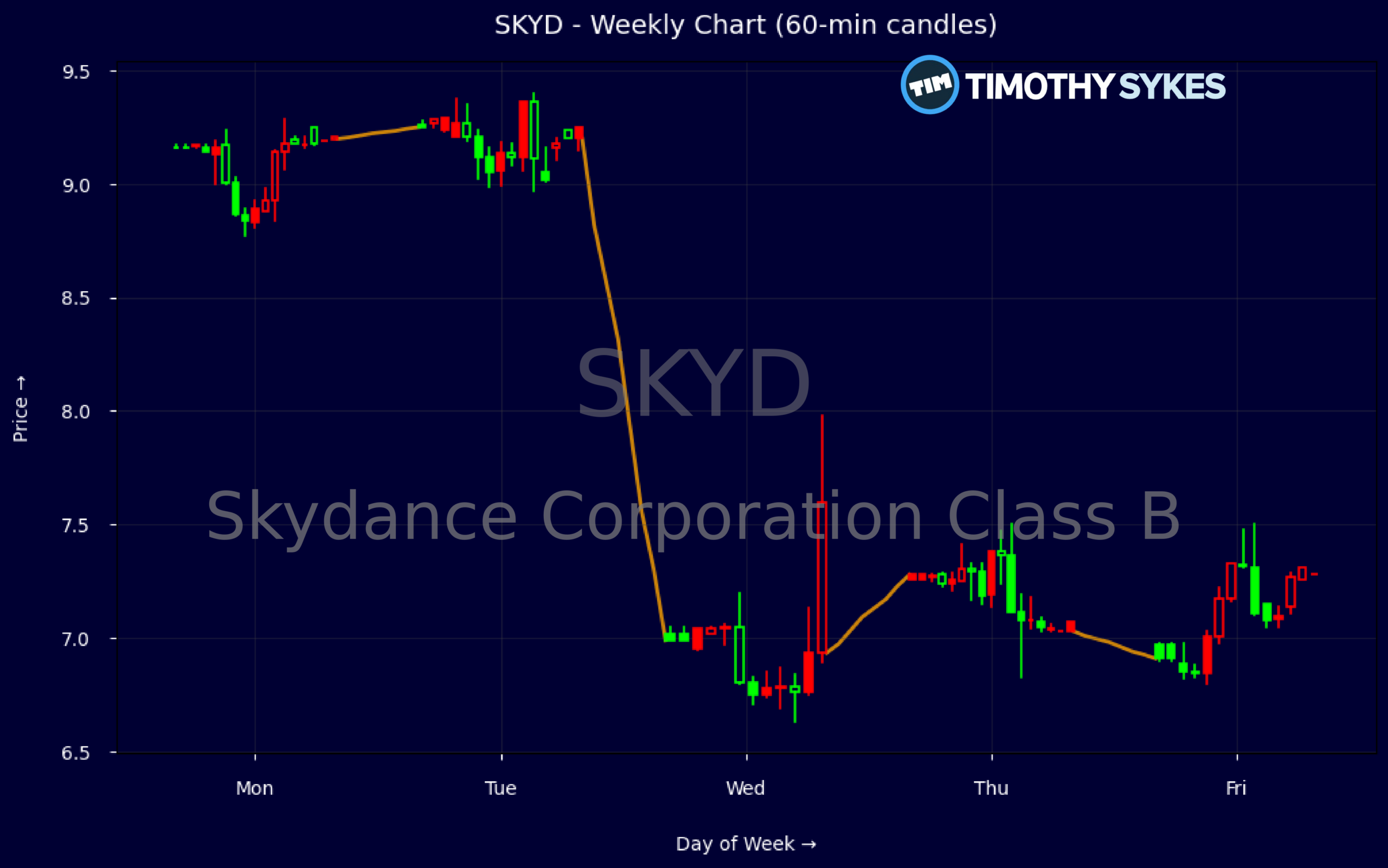
Weekly Update Oct 12 – Oct 16, 2026: On Friday, October 16, 2026 Skydance Corporation Class B stock [NYSE: SKYD] is trending down by -3.99%! Discover the key drivers behind this movement as well as our expert analysis in the detailed breakdown below.
Media & Telecommunications industry expert:
Analyst sentiment – negative
Skydance (SKYD) now screens as a deeply out-of-favor, leveraged media convergent with telecom-like balance sheet characteristics, trading at ~0.4x sales and ~0.9x book despite 55% gross margin and a robust 62.7% EBITDA margin. Top-line is shrinking (3-year revenue CAGR -3.9%), and returns are negative (ROE -2.7%, ROA -0.8%), implying value destruction so far post-transaction. Nonetheless, Q3 free cash flow of $222 million, interest coverage of 13.3x, and adequate liquidity (current ratio ~1.0) indicate no near-term solvency stress despite 1.38x debt/equity and 57% long-term debt-to-capital.
Technically, the stock has broken down sharply from the low-$9s to sub-$7, with the weekly tape showing a failed rebound (7.26 close) followed by renewed selling to 6.97. Dominant trend is firmly bearish, consistent with elevated downside volume on recent news-driven sessions. Immediate reference level is resistance at $7.25–7.30 (prior intraday high and failed bounce); short-term traders should look to fade rallies into that band with tight risk, while only a sustained weekly close back above $9 would signal a meaningful reversal.
Catalysts are dominated by integration risk from the Warner Bros. Discovery asset acquisition, aggressive debt restructuring, and politically charged CNN-related headlines that triggered a 25% drop on heavy volume. Versus Media & Telecom peers, SKYD offers cheaper valuation and better near-term interest coverage but weaker growth and headline risk than diversified streamers and tower operators. Traditional media comps share secular pressure, but SKYD’s leverage and governance overhang warrant a discount. Verdict: Negative, with support near $6.50 and resistance at $7.30; risk-reward improves only sub-$6.
More Breaking News
Quick Financial Overview
Skydance Corporation Class B (SKYD) is trading under clear downside pressure. The weekly data show price breaking from above $9.20 to near $7.00, with a large gap down on 2026/10/14 when the stock plunged to the low $7.00s. That 25% slide on heavy volume, tied to the CNN court order headline, marked a sharp shift in sentiment and turned SKYD into a high‑volatility name in the short term.
Intraday, the most recent session opened around $7.22, pushed briefly above $7.40, then faded steadily into the close near $6.97. The tape shows a trend‑day lower: early strength sold aggressively, then a slow grind down with lower highs from mid‑day onward. For short‑term traders, that intraday pattern confirms sellers in control and sets $7.40–$7.50 as near‑term resistance and the $6.85–$6.90 band as the first support zone to watch.
Fundamentally, Skydance Corporation Class B is a low‑multiple, high‑debt media name. Revenue is about $28.89B with gross margin near 55%, but net margins are slightly negative and returns on equity and assets are below zero, showing thin profitability despite strong EBITDA margin. The balance sheet is heavily leveraged, with long‑term debt around $14.39B and total debt‑to‑equity at 1.38, which explains why the market is reacting strongly to debt restructuring headlines.
Conclusion
This is stock news, not investment advice. Timothy Sykes News delivers real-time stock market news focused on key catalysts driving short-term price movements. Our content is tailored for active traders and investors seeking to capitalize on rapid price fluctuations, particularly in volatile sectors like penny stocks. Readers come to us for detailed coverage on earnings reports, mergers, FDA approvals, new contracts, and unusual trading volumes that can trigger significant short-term price action. Some users utilize our news to explain sudden stock movements, while others rely on it for diligent research into potential investment opportunities.
Dive deeper into the world of trading with Timothy Sykes, renowned for his expertise in penny stocks. Explore his top picks and discover the strategies that have propelled him to success with these articles:
- Penny Stocks Trading Guide
- Best Penny Stocks Under $1 to Buy Today
- Top 8 Penny Stocks to Watch on Robinhood
Once you’ve got some stocks on watch, elevate your trading game with StocksToTrade the ultimate platform for traders. With specialized tools for swing and day trading, StocksToTrade will guide you through the market’s twists and turns.
Dig into StocksToTrade’s watchlists here:





Leave a reply