

SITE Centers Corp. stocks have been trading up by 14.95 percent following upbeat sentiment around its retail real-estate portfolio.
What Traders Need To Know
- SITE Centers is selling its interests in the Dividend Trust Portfolio joint venture for about $32.4M and funding a large $3.00 per-share special cash distribution with due-bill trading.
- The planned $3.00 per share special cash distribution is more than 25% of the current share price, creating a powerful income and event-driven trading catalyst.
- SITE Centers sold its Chicago property The Maxwell for about $15.3M, generating roughly $13.9M in net proceeds and reinforcing its capital recycling approach.
- Recent price action shows SITC spiking from near $3.00 toward the high $3.00s, reflecting traders positioning ahead of the special distribution.
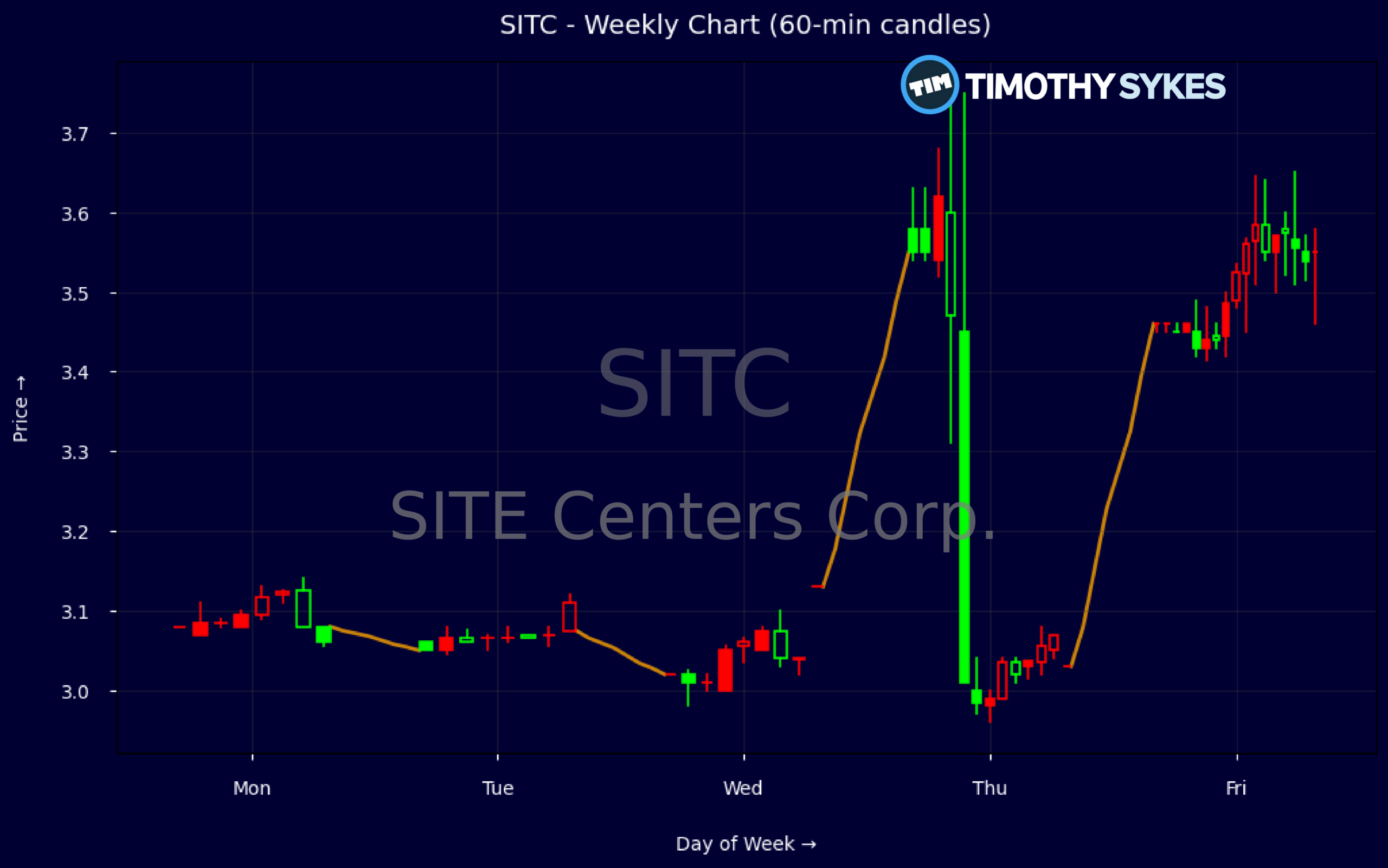
Weekly Update Oct 12 – Oct 16, 2026: On Sunday, October 18, 2026 SITE Centers Corp. stock [NYSE: SITC] is trending up by 14.95%! Discover the key drivers behind this movement as well as our expert analysis in the detailed breakdown below.
Real Estate industry expert:
Analyst sentiment – positive
SITE Centers (SITC) sits in a transitional but relatively strong fundamental position for a retail REIT. The balance sheet is clean with zero debt, current ratio 3.5, and substantial liquidity (cash and equivalents ~\$239M, working capital ~\$171M). Valuation screens optically cheap (P/E 1.48, P/B 0.58, P/S 2.38), reflecting large non-cash unrealized losses and special-distribution mechanics more than true earning power. Capital efficiency remains attractive, with ROE ~16–33% and ROIC >30% on an LTM basis.
Recent quarterly results show pressure on operating performance and cash generation. Revenue of \$10.7M and EBITDA of \$2.7M translated into an operating loss of \$7.4M and modest net loss (EPS -\$0.03), while free cash flow was negative \$10.1M due largely to portfolio pruning and working-capital movements. Nonetheless, interest coverage of 60x and no long-term debt provide high financial flexibility. Key insight: SITC is deliberately monetizing assets, accepting near-term GAAP noise in exchange for balance-sheet resilience and capital return.
Technically, SITC has transitioned from a tight consolidation into a short-term breakout. Over the latest sequence, price moved from a flat 3.02–3.08 range into a sharp spike to 3.7499 and then closed the week near 3.46, signaling aggressive dip buying around 3.00–3.05 and new demand above 3.40. Intraday 5-minute action (not shown numerically but implied by range) supports rising volume on up-moves. Dominant trend is now short-term bullish; actionable level: buy pullbacks toward 3.20–3.25 with a stop below 3.00 and initial resistance/trim zone at 3.75.
The recent announcements are clearly shareholder-friendly and explain both valuation and trading behavior. SITC is selling its Dividend Trust Portfolio interest (~\$32.4M) and Chicago’s The Maxwell (~\$15.3M), then distributing a sizable \$3.00 per-share special cash dividend, over 25% of the current price and triggering due-bill trading. Relative to broader REIT and retail real estate benchmarks, SITC is shifting from a growth/operations story to a capital-return and asset-rationalization story. Verdict: Positive risk/reward; key support 3.00, resistance 3.75, 6–12 month fair value 4.00–4.25 assuming disciplined execution and stable open-air center fundamentals.
More Breaking News
Quick Financial Overview
SITE Centers Corp. (SITC) is clearly in capital-return mode. The company is selling its interests in the Dividend Trust Portfolio joint venture for about $32.4M and pairing that with accumulated cash to pay a $3.00 per-share special cash distribution. For a stock trading a bit above $3.00, that payout size is unusual and immediately puts SITC on the radar of event-driven traders who target special distributions and related price gaps.
On the tape, SITC just shifted from a flat $3.08 area into a sharp move, tagging an intraday high near $3.75 before closing around $3.58, with the next day slipping slightly to about $3.46. That jump from roughly $3.00 to the mid-$3.00s lines up with traders repricing the stock for the announced cash return. A thin intraday 5‑minute bar around $3.59 to $3.43 shows some volatility and profit-taking after the initial spike, which is common after headline-driven moves.
Under the hood, SITE Centers Corp. shows mixed but interesting fundamentals. Revenue sits near $123.6M with a pretax margin around 39.5%, and valuation ratios look compressed, with a price-to-book near 0.58 and a very low stated P/E. At the same time, recent quarterly numbers show a small net loss of about $1.3M and negative free cash flow of roughly $10.1M, offset by strong liquidity with a current ratio of 3.5 and no reported long-term debt. The sale of The Maxwell in Chicago for $15.3M, generating about $13.9M in net proceeds, fits the pattern of monetizing assets to keep cash high and the balance sheet flexible.
Conclusion
SITE Centers Corp. is setting up as a textbook event-driven name in the near term. A $3.00 per-share special cash distribution, worth more than a quarter of the stock’s recent price, is a clear catalyst that will reshape the chart around the record and ex-distribution dates. Due-bill trading means buyers during the specified period will still receive the payout, which can support elevated volume and choppy intraday swings as income-focused players and short-term traders collide.
The recent push from roughly $3.00 to the mid-$3.00s shows the market already pricing in part of this cash return for SITC. At the same time, ongoing sales like The Maxwell and the Dividend Trust Portfolio interest highlight a shrinking asset base, which traders should weigh against the attractive, immediate cash yield. Fundamentals show solid liquidity and low leverage, but also soft recent earnings and negative free cash flow, underlining that this is a capital-recycling and payout story, not a pure growth play.
For traders, the key watchpoints are the behavior into the ex-distribution date, the size of the price gap once the stock trades without the $3.00 entitlement, and whether SITE Centers Corp. can stabilize above post-payout levels. As I tell my students, “Big one-time payouts can create great trades, but the edge comes from planning the gap, not chasing the headline.” As millionaire penny stock trader and teacher Tim Sykes, says, “Preparation plus patience leads to big profits.” In other words, the trading edge here comes from mapping out the scenarios around the special distribution and waiting for high-probability entries, rather than reacting impulsively to the news. This article is for educational and research purposes only.
This is stock news, not investment advice. Timothy Sykes News delivers real-time stock market news focused on key catalysts driving short-term price movements. Our content is tailored for active traders and investors seeking to capitalize on rapid price fluctuations, particularly in volatile sectors like penny stocks. Readers come to us for detailed coverage on earnings reports, mergers, FDA approvals, new contracts, and unusual trading volumes that can trigger significant short-term price action. Some users utilize our news to explain sudden stock movements, while others rely on it for diligent research into potential investment opportunities.
Dive deeper into the world of trading with Timothy Sykes, renowned for his expertise in penny stocks. Explore his top picks and discover the strategies that have propelled him to success with these articles:
- Penny Stocks Trading Guide
- Best Penny Stocks Under $1 to Buy Today
- Top 8 Penny Stocks to Watch on Robinhood
Once you’ve got some stocks on watch, elevate your trading game with StocksToTrade the ultimate platform for traders. With specialized tools for swing and day trading, StocksToTrade will guide you through the market’s twists and turns.
Dig into StocksToTrade’s watchlists here:





Leave a reply