

PDS Biotechnology Corporation faces heightened downside risk as pivotal trial and regulatory uncertainty weigh while stocks have been trading down by -14.92 percent.
What Traders Need To Know
- Existing shareholders registered 16.5M PDS Biotechnology shares for potential resale, increasing potential supply.
- The registration does not involve new shares, so it is not direct dilution.
- PDS Biotechnology will not receive cash from any resale, limiting near-term balance sheet benefit.
- Price has slipped from $1.49 to around $1.11 in recent sessions, signaling pressure.
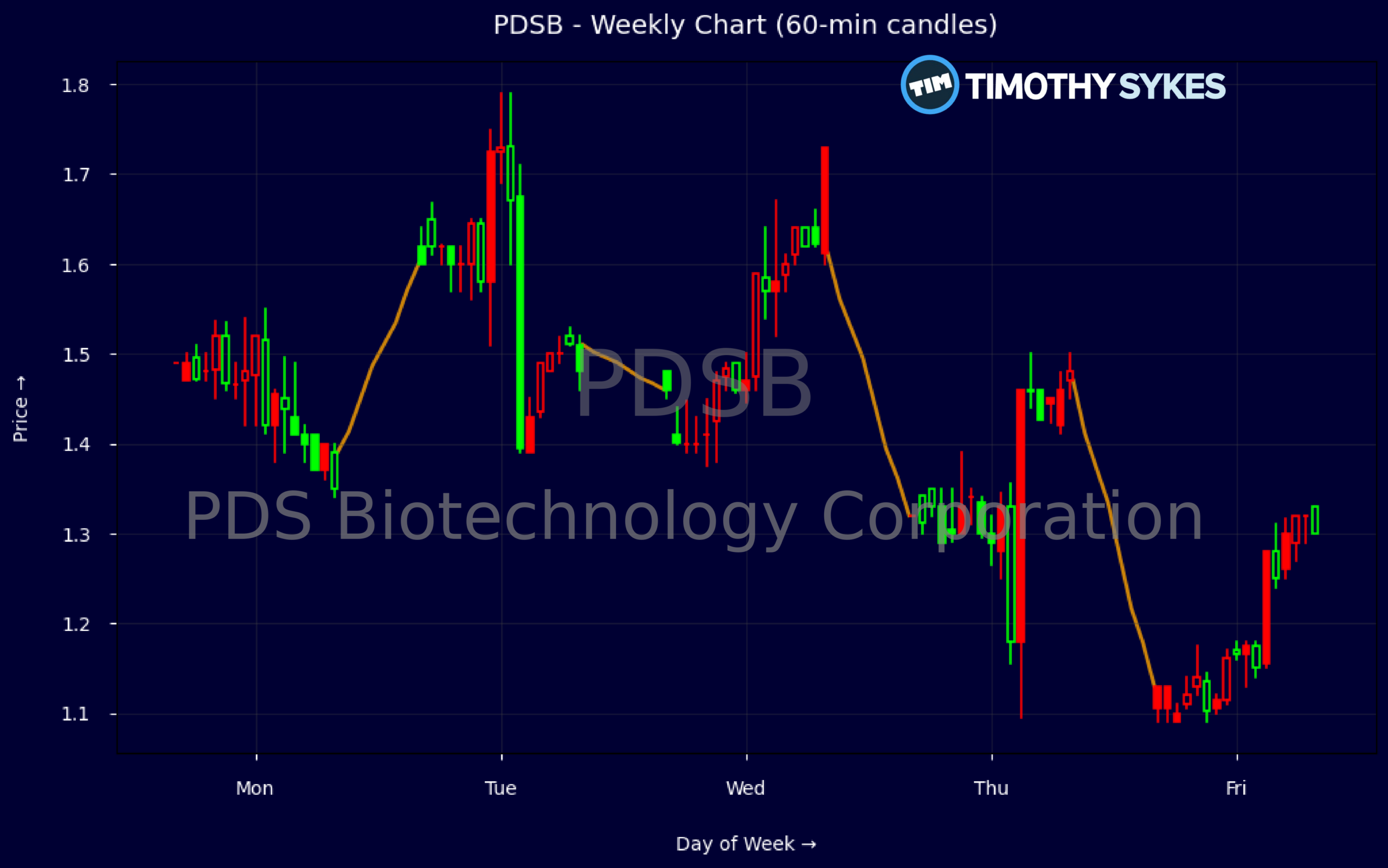
Weekly Update Oct 12 – Oct 16, 2026: On Sunday, October 18, 2026 PDS Biotechnology Corporation stock [NASDAQ: PDSB] is trending down by -14.92%! Discover the key drivers behind this movement as well as our expert analysis in the detailed breakdown below.
Healthcare industry expert:
Analyst sentiment – negative
PDS Biotechnology (PDSB) sits in a distressed micro-cap position with negative equity (stockholders’ equity -$3.6M) and minimal assets ($8.8M) dominated by cash (~$5.6M). Liquidity is tight, with a current ratio of 0.6 and working capital of -$5.3M, signaling near-term financing risk. Operating cash burn of ~$2.8M in the quarter and free cash flow of -$2.8M against an enterprise value of ~$117M implies a high EV/FCF on a pre-revenue story with deeply negative ROA and ROE.
Technically, PDSB is in a clear short-term downtrend: the weekly sequence from $1.62 close (261013) to $1.106 (261016) shows accelerating selling and failed attempts to hold above $1.50. The $1.10 area is now the key near-term pivot; sustained trading below this level, especially on rising 5-minute volume spikes, opens a path toward psychological $1.00 and potential delisting concerns. Tactical traders should treat $1.10–1.15 as a low-conviction bounce zone and $1.50 as a defined upside stop for shorts.
The recent registration of 16.5M existing shares for resale introduces a significant overhang, worsening supply-demand dynamics without bringing in new capital, and is structurally bearish versus healthcare and biotech benchmarks that generally benefit from cleaner cap tables and stronger balance sheets. Without clear late-stage clinical catalysts or near-term partnering cash, risk-reward is skewed to the downside. I see resistance at $1.50, support thin near $1.00, and a 6–12 month risk-weighted bias toward sub-$1 unless financing or pivotal data reset the story.
More Breaking News
Quick Financial Overview
PDSB has been under steady selling pressure across the recent weekly tape. The stock slipped from $1.49 to $1.32, then down to about $1.11, with lower highs and lower lows each day. That pattern shows a controlled but persistent exit by sellers, not a one-off panic candle. On the intraday view, a 5-minute bar with a $1.26 high and a $1.0904 low, closing near $1.13, underlines that dips are being bought but each bounce is getting sold into.
Financially, PDS Biotechnology Corporation is a high-risk, cash-burning small cap. Quarterly net income is roughly -$9.75M, with free cash flow around -$2.79M and operating cash flow also negative. Cash at period end sits near $5.6M against current liabilities above $12.3M, producing a weak current ratio near 0.6 and a quick ratio of 0.5. Negative equity of about -$3.6M, very weak returns on assets and equity, and a price-to-free-cash ratio above 40 all point to a name heavily dependent on market confidence and future funding.
The 16.5M share registration for potential resale adds a clear technical angle. While it is not new issuance, it increases the stock that can legally hit the market, which matters when the enterprise value is around $117.4M and cash is limited. For traders, that can translate into supply overhead on every push higher. PDSB tends to be sensitive to liquidity shifts, so watching how volume behaves if those shares start to move will be key.
Conclusion
PDSB now trades in a tough spot where weak financials, negative cash flow, and a soft chart intersect with a new supply overhang. The registration of 16.5M existing shares for potential resale does not dilute ownership directly, but it does tell traders that some holders may be preparing to sell into strength. With PDS Biotechnology Corporation already sliding from the mid-$1.40s toward $1.10, the tape is confirming that sellers currently have the upper hand.
From a trading education angle, the setup is straightforward: a cash-hungry biotech with negative working capital, negative equity, and a clear technical downtrend now faces extra potential float. Any sharp bounce in PDSB is likely to run into selling pressure from registered holders, unless news or volume radically changes the narrative. That does not mean the stock cannot stage powerful short-term rallies; it means those rallies are fighting both fundamentals and supply mechanics. As I tell my own students, “When a small-cap like PDSB shows a downtrend plus a clear share overhang, you only trade the long side if the volume and intraday trend flip decisively in your favor—and you keep your risk tight.” In this kind of challenging small-cap environment, mindset matters just as much as pattern recognition. As millionaire penny stock trader and teacher Tim Sykes says, “Embrace the journey, the ups and downs; each mistake is a lesson to improve your strategy.”
This is stock news, not investment advice. Timothy Sykes News delivers real-time stock market news focused on key catalysts driving short-term price movements. Our content is tailored for active traders and investors seeking to capitalize on rapid price fluctuations, particularly in volatile sectors like penny stocks. Readers come to us for detailed coverage on earnings reports, mergers, FDA approvals, new contracts, and unusual trading volumes that can trigger significant short-term price action. Some users utilize our news to explain sudden stock movements, while others rely on it for diligent research into potential investment opportunities.
Dive deeper into the world of trading with Timothy Sykes, renowned for his expertise in penny stocks. Explore his top picks and discover the strategies that have propelled him to success with these articles:
- Penny Stocks Trading Guide
- Best Penny Stocks Under $1 to Buy Today
- Top 8 Penny Stocks to Watch on Robinhood
Once you’ve got some stocks on watch, elevate your trading game with StocksToTrade the ultimate platform for traders. With specialized tools for swing and day trading, StocksToTrade will guide you through the market’s twists and turns.
Dig into StocksToTrade’s watchlists here:




Leave a reply