

Targa Resources Inc. stocks have been trading up by 4.37 percent amid bullish sentiment on expanding midstream infrastructure demand.
What Traders Need To Know
- RBC Capital Markets reaffirmed an Outperform on Targa Resources Inc. with a $338 target, stressing strong Permian volumes, returning Waha barrels, and long-term volume contracts despite a minor Q3 estimate trim.
- Multiple banks, including Citi, Goldman Sachs, Bank of America, Barclays, Stifel, Jefferies, and Scotiabank, keep Buy/Outperform views on TRGP with targets mainly in the high-$200s to mid-$330s, above the current high-$280s.
- Several firms flag robust Permian inlet growth and resuming curtailed volumes as key offsets to weaker marketing results and softer Waha spreads for Targa Resources Inc.
- Jefferies cut its TRGP target to $326 from $345 on marketing losses tied to Waha compression and higher LPG freight, yet still expects outsized growth supported by Targa’s Exxon deal.
- A Q3 2026 dividend of $1.25 per share ($5.00 yearly) and an upcoming earnings webcast keep the focus on ongoing capital returns and confirmation of a strong second-half story for TRGP.
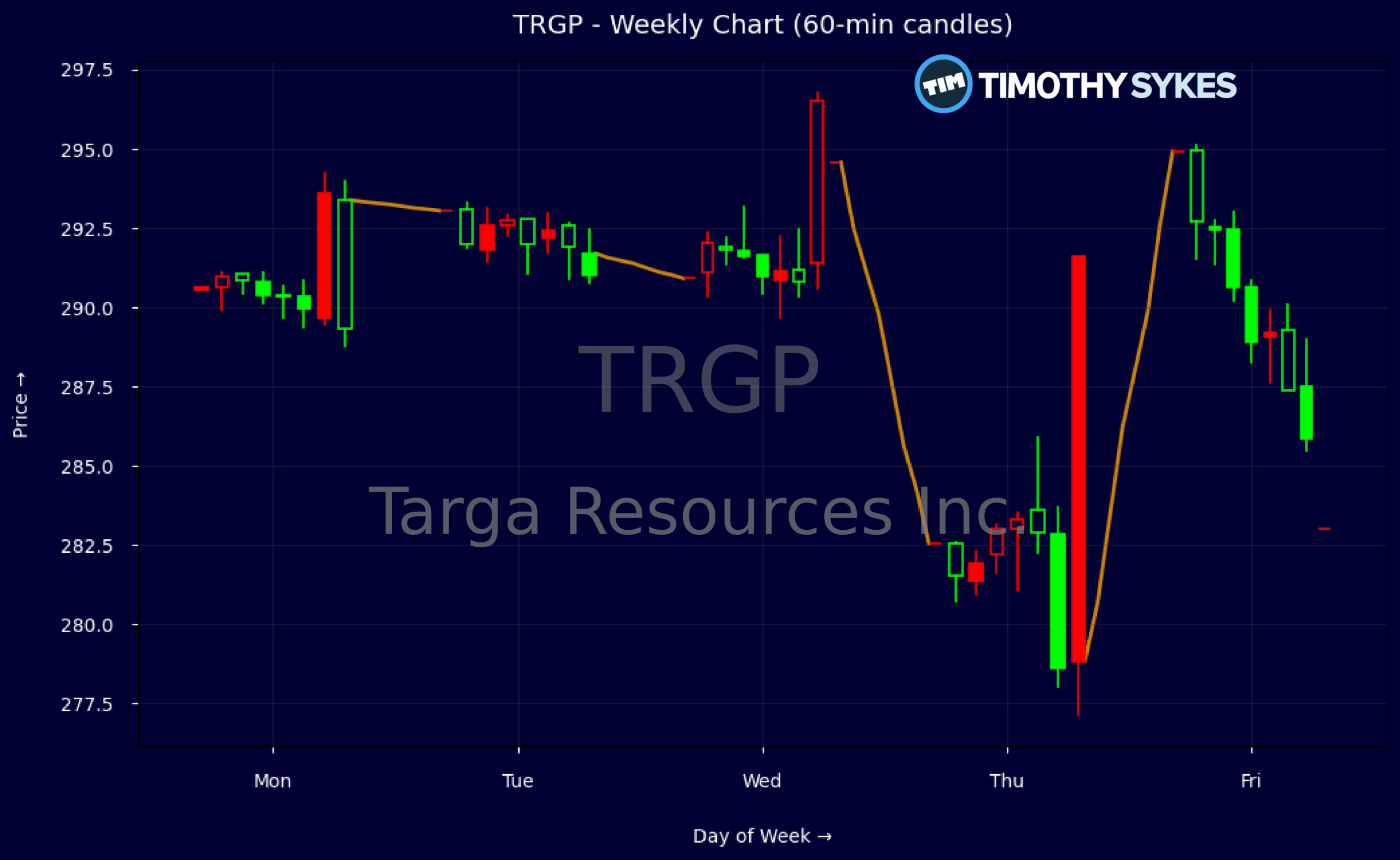
Weekly Update Oct 12 – Oct 16, 2026: On Friday, October 16, 2026 Targa Resources Inc. stock [NYSE: TRGP] is trending up by 4.37%! Discover the key drivers behind this movement as well as our expert analysis in the detailed breakdown below.
Energy industry expert:
Analyst sentiment – positive
Targa Resources is a top-tier US midstream operator with very strong operating fundamentals but an increasingly rich equity valuation and elevated balance sheet risk. EBIT and EBITDA margins of 33% and 43% on $17.0B of revenue, with ROE above 70% and ROIC around 20%, place TRGP at the high end of the midstream peer set. However, 5.2x debt-to-equity, 0.8x current ratio, and 16.8x P/B underscore leverage and liquidity constraints. A 1.8% dividend yield, despite ~40–60% growth over 3–5 years, signals a total-return, not income-first, profile.
Technically, TRGP is in a strong primary uptrend; the weekly tape shows closes marching from ~$282 to ~$295, repeatedly printing higher highs and higher lows with shallow pullbacks, consistent with institutions leaning in on dips. Intraday 5‑minute candles (paired with above-average volume on pushes through $293) confirm buyers absorbing supply near prior highs. One actionable level: $290 is the key pivot—holding above it favors tactical longs with a $305–310 near-term target; a decisive break below $282 would invalidate the momentum setup.
Catalysts are clearly skewed to the upside: multiple bulge-bracket banks have Buy ratings and clustered price targets around $320–330, well above the current high‑$280s, driven by strong Permian inlet growth, returning Waha-related volumes, and Exxon-related volume visibility. Relative to Energy and Fossil Fuels benchmarks, TRGP trades at a premium P/E and P/CF but delivers superior growth, returns on capital, and dividend growth. Base case: maintain an Overweight stance with a 12‑month target of $320, support at $275 and resistance near $300 then $325.
More Breaking News
Quick Financial Overview
Targa Resources Inc. sits in a sweet spot where bullish research calls, solid fundamentals, and a firm tape line up. Across the week, TRGP traded roughly between $282 and $295, finishing near $294.90, which keeps it just below clustered analyst targets in the low-to-mid $300s. Intraday action shows a controlled grind higher from the mid-$280s at the open to the mid-$290s into the close, with shallow pullbacks getting bought and no aggressive selling pressure.
On the operations side, Targa Resources Inc. produced about $4.44B in quarterly revenue and $1.69B in EBITDA, translating into an EBITDA margin above 40%. That kind of margin, paired with EBIT margin above 30% and net income near $765M, signals a high-quality midstream operator with strong pricing power and scale. Return on equity metrics north of 40% show that management is squeezing a lot out of a highly leveraged balance sheet, even though total debt to equity above 5 and a current ratio below 1 flag balance-sheet risk that traders should not ignore.
Valuation-wise, TRGP trades on a price-to-earnings around 27 and price-to-sales near 3.7, rich versus some midstream peers but partly justified by strong Permian growth and high returns on capital above 20%. Enterprise value is about $80B against revenue of roughly $17.0B, which shows the market is paying up for growth visibility, Waha-volume recovery, and long-duration contracts referenced by RBC and Goldman. The declared $5.00 annualized dividend, with yield around 1.8% and rapid multi-year dividend growth, tells traders that Targa Resources Inc. is balancing expansion capex with consistent cash returns, a mix that often supports dips ahead of catalysts like the pending Q3 2026 earnings release.
Conclusion
This is stock news, not investment advice. Timothy Sykes News delivers real-time stock market news focused on key catalysts driving short-term price movements. Our content is tailored for active traders and investors seeking to capitalize on rapid price fluctuations, particularly in volatile sectors like penny stocks. Readers come to us for detailed coverage on earnings reports, mergers, FDA approvals, new contracts, and unusual trading volumes that can trigger significant short-term price action. Some users utilize our news to explain sudden stock movements, while others rely on it for diligent research into potential investment opportunities.
Dive deeper into the world of trading with Timothy Sykes, renowned for his expertise in penny stocks. Explore his top picks and discover the strategies that have propelled him to success with these articles:
- Penny Stocks Trading Guide
- Best Penny Stocks Under $1 to Buy Today
- Top 8 Penny Stocks to Watch on Robinhood
Once you’ve got some stocks on watch, elevate your trading game with StocksToTrade the ultimate platform for traders. With specialized tools for swing and day trading, StocksToTrade will guide you through the market’s twists and turns.
Dig into StocksToTrade’s watchlists here:





Leave a reply