
timothy sykes logo
Alphabet Climbs 3% On Canadian Bond Sale Thumbnail

Alphabet Climbs 3% On Canadian Bond Sale

TIMOTHY SYKES•UPDATED NOV. 20, 2026, 9:45 AM ET

Alphabet rose 3% after setting terms for Canadian-dollar borrowing that adds funds for company needs, including possible debt repayment.
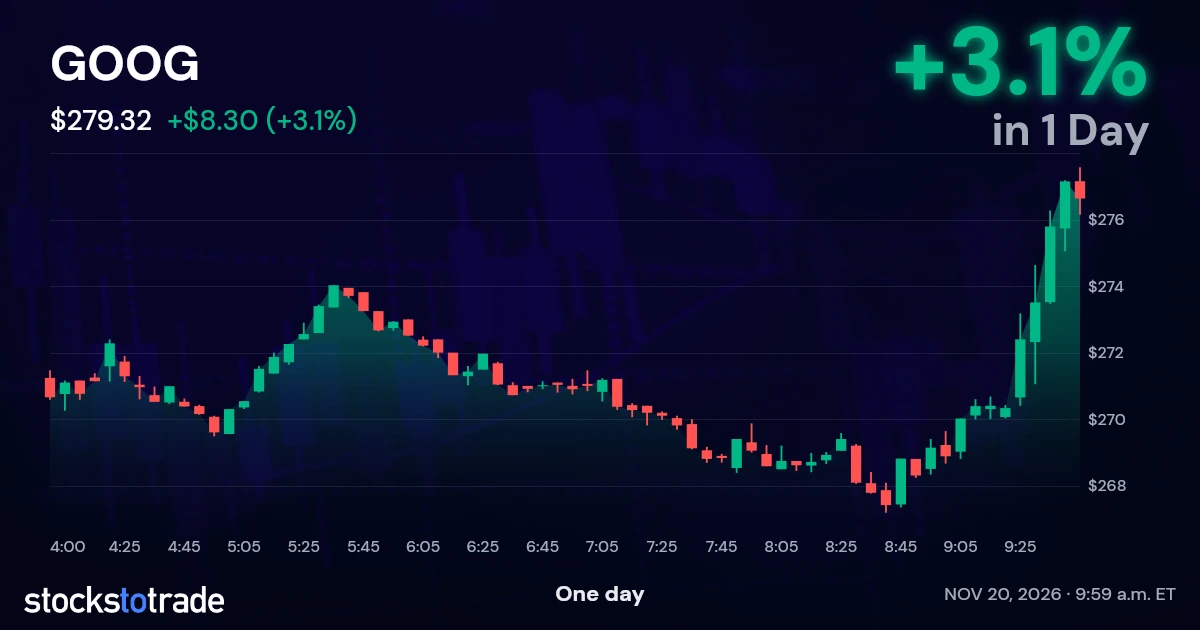
GOOG Candlestick Chart

Why Alphabet Stock Is Up Today

Alphabet Inc. (NASDAQ: GOOG) rose 3% to $279.32 this morning after pricing its Canadian-dollar bond sale, meaning it set the borrowing terms. The financing gives Alphabet more room to cover company needs.

Alphabet’s $4,200,000,000 Canadian Bond Sale

Alphabet agreed to borrow $4,200,000,000 through its Canadian-dollar bond sale from investors whose individual names were not disclosed. The bonds require repayment over different years, rather than all at once. The proceeds are for general company purposes, including possible debt repayment, rather than a named project.

Alphabet Senior Notes Explained

The senior notes are loans repaid with interest, with repayment priority over lower-ranking debt. They provide funding rather than customer sales. That makes this a financing benefit, not evidence that demand for Alphabet’s services has improved.

Alphabet Shares Approach a high near $280

Shares moved from the $270 level toward a high near $280 during regular trading. The advance recovered ground during the session without giving back most of the gain.

Quick Financial Overview

Alphabet is a profitable heavyweight and a large-cap, with $3,433.96B in stock market value, the price investors place on all its shares. It reported $265.10B in cash, cash equivalents, and short-term investments as of September 30, 2026, including money on hand and investments that can be sold quickly.

Alphabet Revenue And Earnings

The latest quarter brought revenue of $127.58B and net income of $26.47B. Revenue measures sales before costs, while net income is profit after expenses. Those earnings show an established business behind today’s financing news.

Alphabet Borrowing Costs And Repayment

Borrowing creates interest bills as well as an obligation to return the amount borrowed. Access to funds can help Alphabet manage payments, but the benefit must be weighed against those costs.

Alphabet Share Offering Risk

Recent documents updating offering terms do not by themselves establish a sale of common shares. The announced debt does not give lenders an ownership stake. It therefore does not, on its own, reduce existing shareholders’ percentage ownership.

Alphabet Stock Remains Below the $320 level

Alphabet traded around the $320 level a month ago, leaving today’s rebound within a broader decline. A single rising session does not establish that the slide has ended. For context, the last daily move this large was four sessions ago.

Alphabet’s Earlier Gains Faded

We covered Alphabet’s early gains fading yesterday. That earlier retreat adds context to today’s recovery, without establishing that buyers have ended the broader decline.

Alphabet Bond Settlement Comes Next Tuesday

The notes are scheduled to settle next Tuesday, when investors exchange payment for the bonds. Setting terms comes before that exchange. Completion is therefore the next concrete step in the transaction.

Conclusion

Successful completion at the scheduled settlement would turn Alphabet’s agreed financing into usable funds. A delay would leave that step unfinished, while neither outcome alone would show stronger sales or better profit.

This is stock news, not investment advice. Timothy Sykes News delivers real-time stock market news focused on key catalysts driving short-term price movements. Our content is tailored for active traders and investors seeking to capitalize on rapid price fluctuations, particularly in volatile sectors like penny stocks. Readers come to us for detailed coverage on earnings reports, mergers, FDA approvals, new contracts, and unusual trading volumes that can trigger significant short-term price action. Some users utilize our news to explain sudden stock movements, while others rely on it for diligent research into potential investment opportunities.

Dive deeper into the world of trading with Timothy Sykes, renowned for his expertise in penny stocks. Explore his top picks and discover the strategies that have propelled him to success with these articles:

Once you’ve got some stocks on watch, elevate your trading game with StocksToTrade the ultimate platform for traders. With specialized tools for swing and day trading, StocksToTrade will guide you through the market’s twists and turns.
Dig into StocksToTrade’s watchlists here:



How much has this post helped you?


Leave a reply

* Results are not typical and will vary from person to person. Making money trading stocks takes time, dedication, and hard work. There are inherent risks involved with investing in the stock market, including the loss of your investment. Past performance in the market is not indicative of future results. Any investment is at your own risk. See Terms of Service here

The available research on day trading suggests that most active traders lose money. Fees and overtrading are major contributors to these losses.

A 2000 study called “Trading is Hazardous to Your Wealth: The Common Stock Investment Performance of Individual Investors” evaluated 66,465 U.S. households that held stocks from 1991 to 1996. The households that traded most averaged an 11.4% annual return during a period where the overall market gained 17.9%. These lower returns were attributed to overconfidence.

A 2014 paper (revised 2019) titled “Learning Fast or Slow?” analyzed the complete transaction history of the Taiwan Stock Exchange between 1992 and 2006. It looked at the ongoing performance of day traders in this sample, and found that 97% of day traders can expect to lose money from trading, and more than 90% of all day trading volume can be traced to investors who predictably lose money. Additionally, it tied the behavior of gamblers and drivers who get more speeding tickets to overtrading, and cited studies showing that legalized gambling has an inverse effect on trading volume.

A 2019 research study (revised 2020) called “Day Trading for a Living?” observed 19,646 Brazilian futures contract traders who started day trading from 2013 to 2015, and recorded two years of their trading activity. The study authors found that 97% of traders with more than 300 days actively trading lost money, and only 1.1% earned more than the Brazilian minimum wage ($16 USD per day). They hypothesized that the greater returns shown in previous studies did not differentiate between frequent day traders and those who traded rarely, and that more frequent trading activity decreases the chance of profitability.

These studies show the wide variance of the available data on day trading profitability. One thing that seems clear from the research is that most day traders lose money .

Millionaire Media 66 W Flagler St. Ste. 900 Miami, FL 33130 United States (888) 878-3621 This is for information purposes only as Millionaire Media LLC nor Timothy Sykes is registered as a securities broker-dealer or an investment adviser. No information herein is intended as securities brokerage, investment, tax, accounting or legal advice, as an offer or solicitation of an offer to sell or buy, or as an endorsement, recommendation or sponsorship of any company, security or fund. Millionaire Media LLC and Timothy Sykes cannot and does not assess, verify or guarantee the adequacy, accuracy or completeness of any information, the suitability or profitability of any particular investment, or the potential value of any investment or informational source. The reader bears responsibility for his/her own investment research and decisions, should seek the advice of a qualified securities professional before making any investment, and investigate and fully understand any and all risks before investing. Millionaire Media LLC and Timothy Sykes in no way warrants the solvency, financial condition, or investment advisability of any of the securities mentioned in communications or websites. In addition, Millionaire Media LLC and Timothy Sykes accepts no liability whatsoever for any direct or consequential loss arising from any use of this information. This information is not intended to be used as the sole basis of any investment decision, nor should it be construed as advice designed to meet the investment needs of any particular investor. Past performance is not necessarily indicative of future returns.

Citations for Disclaimer

Barber, Brad M. and Odean, Terrance, Trading is Hazardous to Your Wealth: The Common Stock Investment Performance of Individual Investors. Available at SSRN: “Day Trading for a Living?”

Barber, Brad M. and Lee, Yi-Tsung and Liu, Yu-Jane and Odean, Terrance and Zhang, Ke, Learning Fast or Slow? (May 28, 2019). Forthcoming: Review of Asset Pricing Studies, Available at SSRN: “https://ssrn.com/abstract=2535636”

Chague, Fernando and De-Losso, Rodrigo and Giovannetti, Bruno, Day Trading for a Living? (June 11, 2020). Available at SSRN: “https://ssrn.com/abstract=3423101”