

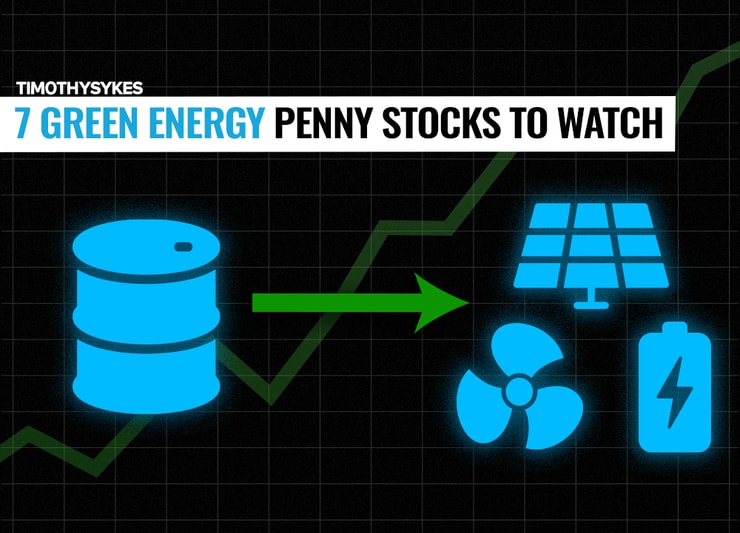


Green energy penny stocks are low-priced shares of small companies in solar, wind, hydrogen, batteries and renewable fuels, and right now they move on oil, not on climate policy. When the Strait of Hormuz closed early in 2026 and crude spiked past $100, money rotated into anything that replaces a barrel.
I’ve traded hot sectors for more than 25 years, and this one behaves like every other: a real story on top, sketchy companies underneath, and a crowd that buys the fourth spike. The opportunity and the trap are the same thing.
Want a shorter time frame than a sector rotation? Here’s how I trade on the weekends:
Learn how my Weekend Windfall trades work.

© Millionaire Media, LLC
Here are the seven names on my screen right now:
| Ticker | Company | Performance (YTD) |
|---|---|---|
| NASDAQ: OPAL | OPAL Fuels | |
| NASDAQ: FTCI | FTC Solar | |
| NASDAQ: ABAT | American Battery Technology | |
| NASDAQ: AQMS | Aqua Metals | |
| NASDAQ: PLUG | Plug Power | |
| NASDAQ: BLDP | Ballard Power Systems | |
| NASDAQ: CBAT | CBAK Energy |
This is a watchlist, not a buy list. I don’t own these stocks, and I won’t buy any unless the price action sets up into a pattern I’ve traded successfully before. Let’s get to the stocks.
Table of Contents
- 1 OPAL Fuels (NASDAQ: OPAL)
- 2 FTC Solar (NASDAQ: FTCI)
- 3 American Battery Technology (NASDAQ: ABAT)
- 4 Aqua Metals (NASDAQ: AQMS)
- 5 Plug Power (NASDAQ: PLUG)
- 6 Ballard Power Systems (NASDAQ: BLDP)
- 7 CBAK Energy (NASDAQ: CBAT)
- 8 Green Energy Companies You Should Know About
- 9 What Counts as a Green Energy Penny Stock
- 10 How I Screen Green Energy Penny Stocks
- 11 The Catalysts That Move This Sector
- 12 What I Tell Students About Trading Green Energy Stocks
- 13 What Are the Risks of Trading Green Energy Penny Stocks?
- 14 Is Today a Good Time to Buy Green Energy Penny Stocks?
- 15 Sign Up for My FREE Weekly Watchlist
- 16 Key Takeaways
- 17 Frequently Asked Questions
- 17.1 What Is a Green Energy Penny Stock?
- 17.2 Are Green Energy Penny Stocks a Good Investment?
- 17.3 Which Green Energy Sector Is the Most Volatile?
- 17.4 How Do Oil Prices Affect Green Energy Penny Stocks?
- 17.5 How Much Money Do You Need to Trade Green Energy Penny Stocks?
- 17.6 Do You Hold Green Energy Penny Stocks Overnight?
OPAL Fuels (NASDAQ: OPAL)
OPAL Fuels turns landfill and dairy gas into renewable natural gas for trucking fleets, so it has real revenue. Second quarter results on Aug. 10 showed adjusted EBITDA up 40% from a year ago, with the 45Z Clean Fuel Production Credit finally in the numbers. The stock moves on fuel-credit headlines and natural gas prices, and it moves slower than the rest of this list, so I watch it for a multi-day breakout.
FTC Solar (NASDAQ: FTCI)
FTC Solar makes the frames that tilt utility-scale solar panels toward the sun. Revenue in the quarter reported Aug. 5 was $26.2 million, up 52% from the prior quarter. Gross margin is still negative, the company breached a cash covenant, and it set up a $20 million equity line to sell shares into any rally. Good headlines, thin cash, dilution waiting. Trade the spike. Don’t marry it.
American Battery Technology (NASDAQ: ABAT)
American Battery Technology recycles used lithium batteries at a Nevada plant. Its fiscal fourth quarter, reported Aug. 20, showed record revenue of $8.2 million, $50.3 million in cash, no debt, and a $57 million Department of Energy grant reinstated on appeal. The risk is a new federal directive that could block exports of black mass, the shredded battery material that makes up most of its sales. Grant headlines and lithium prices spike this one.
Aqua Metals (NASDAQ: AQMS)
Aqua Metals is a lithium recycling company with no revenue yet and only about 3.5 million shares outstanding after a reverse split. It ended June with $4.7 million in cash against a $4.5 million quarterly loss, and on Aug. 31 it signed a letter of intent to sell all the lithium from a campus it hasn’t built yet. A share count that small turns any headline into a violent move, and the cash math says a share sale is coming.
Plug Power (NASDAQ: PLUG)
Plug Power sells hydrogen fuel cells for forklifts and the equipment that makes hydrogen, and it’s the former runner every hydrogen trader knows. The Aug. 10 quarter was its best in years: $178.3 million in revenue and gross margin near break-even after negative 31% a year ago. It still burns cash and keeps a $2 billion equity facility it can draw on. Plug gaps up on every hydrogen headline and gives it back on every share sale. That’s a pattern, not a prediction.
Ballard Power Systems (NASDAQ: BLDP)
Ballard Power Systems builds hydrogen fuel cell engines for buses, trucks and trains, and it isn’t fighting for its life. Second quarter revenue, reported July 31, was $20.6 million, up 15%, gross margin swung to 20% from negative 8%, and the company held $502 million in cash with no debt. It also agreed to buy GeoPura for 275 million pounds, which spends more than half that cash. Ballard is the sympathy play when Plug runs, with far less bankruptcy risk.
CBAK Energy (NASDAQ: CBAT)
CBAK Energy is a China-based maker of cylindrical lithium-ion battery cells. First quarter revenue nearly doubled to $69.6 million, but gross margin fell to about 1.5%. Since then it landed an order worth roughly $96 million from an Indian two- and three-wheeler maker. The stock trades around a dollar. China-based small caps carry extra headline risk on tariffs and delisting talk, so I treat every run as a day trade.

Green Energy Companies You Should Know About
The renewable energy sector is large, so you shouldn’t keep every company on your watchlist. But it does make sense to keep these sector leaders on your radar as we enter 2025.
Brookfield Renewable Partners LP (NYSE: BEP)

Brookfield Renewable is a renewable power asset company from Canada. It owns and operates various hydroelectric, wind, and solar power plants worldwide.
First Solar Inc. (NASDAQ: FSLR)
First Solar is a solar power system design and manufacturing company. It uses thin-film semiconductors to create its products and sells them to customers worldwide.
Enphase Energy Inc. (NASDAQ: ENPH)
Enphase creates clean energy solutions that merge solar generation, energy storage, and power management on one platform. This California-based company is one of the fastest-growing residential solar providers in the U.S.
Ormat Technologies Inc. (NYSE: ORA)
Unlike most companies in the sector, Ormat Technologies specializes in geothermal energy. Compared to solar and wind power, geothermal power has a more predictable power output since it comes from heat produced from inside the earth. However, it’s expensive — and can cause earthquakes!
SPI Energy Co., Ltd. (NASDAQ: SPI)
SPI Energy made its name in the renewable energy industry in the solar power, energy storage, and electric vehicle fields. It’s a jack-of-all-trades player with high potential. And it’s a penny stock, so you know I’ve got my eye on it.

What Counts as a Green Energy Penny Stock
A green energy penny stock is a low-priced, thinly traded share of a company whose business is replacing fossil fuel, and how it trades is what qualifies it, not the price. A $3 stock that runs to $12 on a hydrogen headline is still a penny stock. First Solar and Brookfield Renewable are the large renewable energy stocks that set the mood for the group, and they are not penny stocks.
The Sectors Inside It
The sectors inside green energy are solar, wind, hydrogen fuel cell companies, battery storage and lithium recycling, and renewable fuels such as renewable natural gas and sustainable aviation fuel. Solar penny stocks trade on panel prices and tariffs. Hydrogen fuel cell stocks trade on whichever company raised money last. Sector rotation inside the sector is real, and the sympathy play works best when you know which sub-sector is hot.
How I Screen Green Energy Penny Stocks
This is the same simple screen I’ve used for more than 25 years. It doesn’t take long to learn.
Step 1: Exchange and Price
The first step is I filter by exchange and price. I want a Nasdaq listing or an NYSE listing, because a listed stock has real reporting rules. OTC stocks, which trade off the main exchanges, get a look only if volume is huge. Then I want low-priced names that have already moved, because I trade momentum, not bargains.
Step 2: Volume and Liquidity
The second step is volume, meaning how many shares trade in a day. I need enough that I can exit in one click. A low float, meaning few shares available to trade, is a bonus because it makes spikes bigger.
Step 3: Catalyst
The third step is the catalyst, the reason the stock is moving today. In this sector that’s an earnings beat, a project award, a grant, a tax credit ruling or an oil price shock. No catalyst, no trade.
Step 4: Filings and Cash
The fourth step is filings and cash. I read the last quarterly filing for two numbers: cash on hand and quarterly loss. If cash covers less than a year of losses, dilution will cap the spike. I also check for an equity line, paperwork that lets a company sell stock into a rally. Here’s how I run this scan going into a weekend:
Embed https://www.youtube.com/watch?v=B-2Zt30G-xQ
The Catalysts That Move This Sector
Three catalysts move this sector.
Earnings and Guidance
Earnings and guidance are the cleanest catalyst because they come on a schedule. A small company that beats and raises guidance can run for days, and one that misses can lose half its value before the open. I don’t hold a penny stock through the report.
Policy and Tax Credits
Policy and tax credits move the whole group at once. The 2025 tax law cut the solar and wind credits short, kept them for battery storage and fuel cells, and extended the 45Z Clean Fuel Production Credit, which pays producers of low-carbon fuels, through 2029. Every rumor about the next change is a trading day, and tariffs work the same way.
Oil Prices and Geopolitics
Oil prices and geopolitics are the catalyst that put this sector back on my screen in 2026. The Strait of Hormuz closure pulled millions of barrels a day off the market, the IEA called it the largest supply disruption in history, and that kind of oil price shock makes every penny stock in the power sector a substitute in the crowd’s mind. The stocks rise on the war headline and fade on the ceasefire headline. I trade the reaction, not the war:
Embed https://www.youtube.com/watch?v=yIAbiC5_E6A
What I Tell Students About Trading Green Energy Stocks
What I tell students about trading green energy stocks comes down to two things: size small and stop chasing.
Position Sizing in a Policy-Driven Sector
Position sizing in a policy-driven sector means smaller than you want. One headline out of Washington or the Gulf can gap these stocks 30% either way overnight, so I size every trade as if that gap is coming. I take singles. Singles add up.
The Mistakes I See Most
The mistakes I see most are chasing the fourth green day, believing the story instead of the chart, and holding through dilution because the story sounds good. Trading Challenge students see my trades in real time as I place them, not so you can copy them, because copying somebody else’s entry teaches you nothing, but so you can see what I looked at, what I passed on, and why.
What Are the Risks of Trading Green Energy Penny Stocks?
The risks of trading green energy penny stocks are the same three that kill traders in every hot sector.
Dilution
Dilution is when a company sells new shares and every existing share becomes a smaller slice. Green energy companies burn cash for years before profit, so they sell stock into every rally. When you see an equity line or shelf filing, expect the spike to get sold.
Policy Reversal
Policy reversal is a sector-wide risk you can’t diversify away. When a credit is cut or a tariff lands, every name in the group gaps down together. That’s why I don’t hold these into a vote or a ruling.
Thin Liquidity
Thin liquidity means you can’t get out at the price on your screen. In a panic, a stock that trades a few hundred thousand shares a day has no bids at all. Size to what you can exit in one order.
Is Today a Good Time to Buy Green Energy Penny Stocks?
No day is a good time to buy green energy penny stocks and hold them, and today is a good time to watch them. Global renewable capacity reached 4,448 gigawatts at the end of 2024 after a record 585 gigawatts were added, according to IRENA. None of it tells you what a stock does tomorrow, so study the best renewable energy stocks alongside the penny names and wait for the chart.
Sign Up for My FREE Weekly Watchlist
Every week I send out the stocks I’m watching and why, at no cost.
Sign up for my free weekly watchlist here.

Key Takeaways
Here’s what matters:
- Green energy penny stocks move on oil and policy headlines, not climate goals.
- Screen for exchange, volume, catalyst and cash, in that order.
- Dilution is the default here. Find the equity line before you trade.
- Size small, take singles, and don’t hold through a policy vote.
The screen is simple. Applying it with real money moving is the hard part.
Apply for my Trading Challenge and learn to trade these setups yourself.
Frequently Asked Questions
What Is a Green Energy Penny Stock?
A green energy penny stock is a low-priced, thinly traded share of a small company in solar, wind, hydrogen, batteries or renewable fuels. How it trades makes it a penny stock.
Are Green Energy Penny Stocks a Good Investment?
Green energy penny stocks are not a good investment for most people, because most of these companies never reach profit and dilute for years. I trade them for days, not years.
Which Green Energy Sector Is the Most Volatile?
Hydrogen has been the most volatile green energy sector, because the companies burn the most cash and raise the most money, so every headline swings both ways. Small solar names are close behind.
How Do Oil Prices Affect Green Energy Penny Stocks?
Oil prices push green energy penny stocks up when crude spikes, because the crowd treats renewables as a substitute, and they fade when oil calms down. The move rarely outlasts the headline.
How Much Money Do You Need to Trade Green Energy Penny Stocks?
You need less money than most people think to trade green energy penny stocks, because I trade small and take singles. You need a plan for the loss more than you need money.
Do You Hold Green Energy Penny Stocks Overnight?
I rarely hold green energy penny stocks overnight, because a policy headline or a share sale can gap them 30% before the open.

Leave a reply