

Regeneron Pharmaceuticals Inc. stocks have been trading up by 13.17 percent following strong positive sentiment around new treatment advances.
What Traders Need To Know
- Nearly four-year C-POST data show adjuvant Libtayo cutting death risk in high-risk skin cancer, with overall survival benefit strengthening over time and disease-free survival holding up despite heavy crossover.
- Canaccord and TD Cowen raised price targets on REGN to $922 and $980, highlighting Dupixent durability, Eylea HD mix shift, and C5 pipeline catalysts into 2026.
- Multiple banks, including Piper Sandler and Evercore, keep overweight/Buy stances, though one Evercore trim to $850 shows some valuation pushback near current prices.
- A new BARDA deal extends Inmazeb Ebola supply to the U.S. government through 2031 for about $270M, adding steady contract revenue backed by strong mortality data.
- A positive EU opinion on a more flexible Libtayo dosing regimen could support better adherence and incremental European oncology growth if the European Commission signs off.
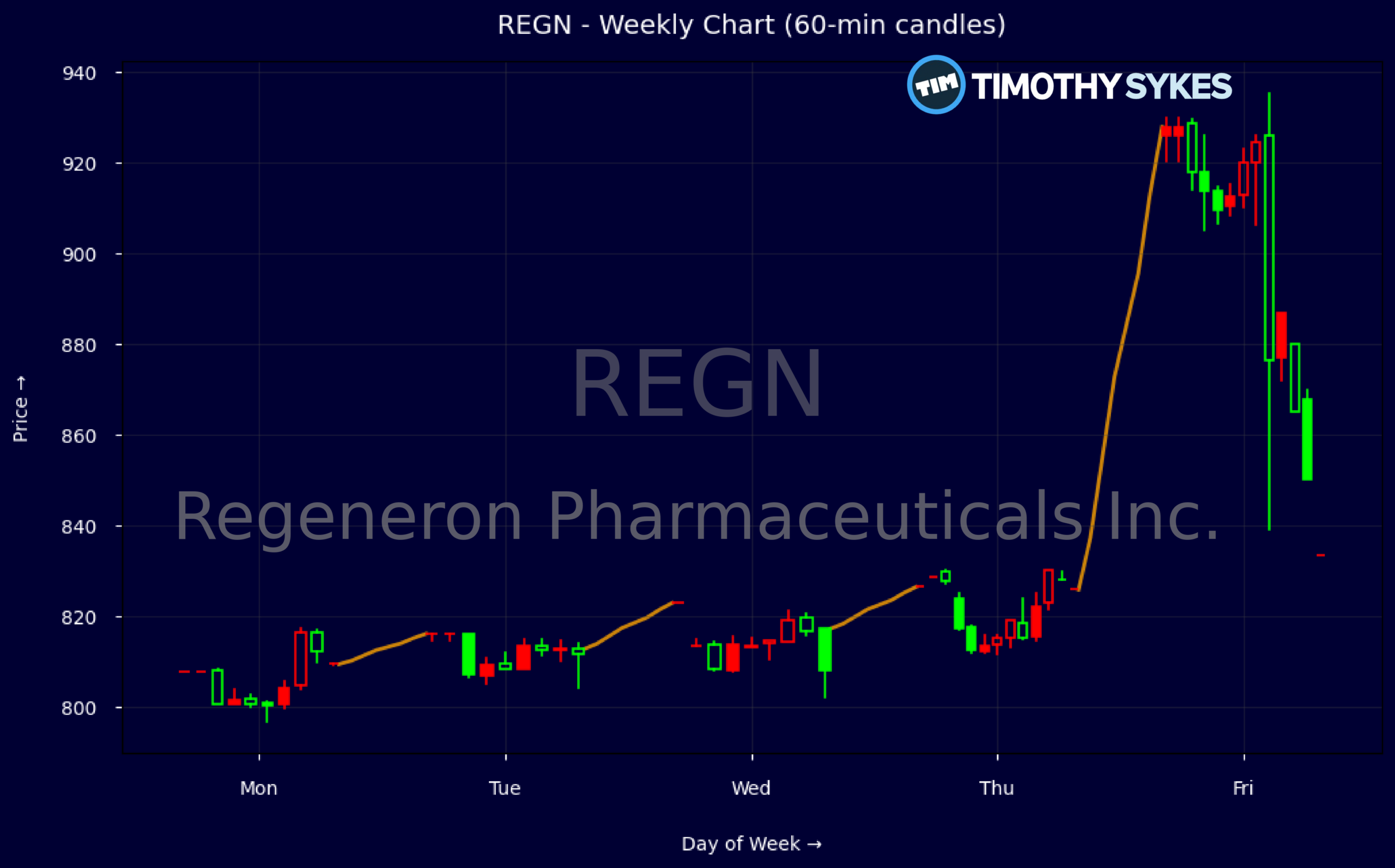
Weekly Update Oct 26 – Oct 30, 2026: On Friday, October 30, 2026 Regeneron Pharmaceuticals Inc. stock [NASDAQ: REGN] is trending up by 13.17%! Discover the key drivers behind this movement as well as our expert analysis in the detailed breakdown below.
Healthcare industry expert:
Analyst sentiment – positive
Regeneron holds a top-tier position in large-cap biotech, combining scale with specialty focus in immunology and ophthalmology. Fundamentals are exceptionally strong: gross margin at 88.6% and EBIT margin above 30% reflect a high-value biologics mix, while ROE of ~14–18% and ROIC ~14% signal efficient capital deployment. Revenue growth (7% three-year CAGR) is solid for its size, with modest multiple (P/E 18.5x, ~5x sales) and minimal leverage (D/E 0.09, interest coverage ~95x), supporting durable cash returns.
Technically, REGN is in a powerful upside breakout on the weekly chart, ripping from the low $800s into the mid-$920s with a clear expansion in range, confirming strong institutional demand. Recent 5-minute candles show persistent buying on dips and shallow intraday pullbacks, consistent with momentum accumulation rather than distribution. The first actionable level is $900–905, now key support; aggressive longs can buy pullbacks there with a stop near $870, targeting a retest and extension through $950–960.
Near-term catalysts are skewed positively: durable C-POST Libtayo survival data, CHMP endorsement of more flexible dosing, and extended Inmazeb BARDA supply underpin oncology and infectious disease durability, while Street revisions (targets clustered ~$865–980, all Buy/Overweight) reflect continued confidence in Eylea HD and Dupixent plus C5/gMG optionality. Versus healthcare and biotech benchmarks, REGN offers superior profitability, cleaner balance sheet, and more visible growth drivers. I expect outperformance, with a 6–12 month fair value zone of $975–1,000 and major technical support anchored at $900.
More Breaking News
Quick Financial Overview
Regeneron Pharmaceuticals Inc. is trading near the top of its recent range after a sharp weekly ramp from the low-$800s to roughly the mid-$920s. The weekly data show a steady climb from about $808 to a recent close around $926, with a notable gap-up and expansion in range on the latest bar. That pattern signals aggressive demand stepping in ahead of and around the positive Libtayo updates and a wave of bullish analyst target hikes.
On the intraday tape, REGN shows a classic trend-day character. After an explosive opening drive from the high-$860s into the $910–$930 band, price consolidated in a relatively tight channel, with repeated dip-buys near $908–$912 and shallow pullbacks being absorbed quickly. For short-term traders, that intraday structure points to strong underlying buying pressure and a clear intraday support zone just above $910, with supply emerging closer to $930.
Fundamentally, the numbers back the strength in the chart. Regeneron Pharmaceuticals Inc. runs at very high quality margins, with gross margin around 88.6% and EBIT margin near 30.6%, on trailing revenue of about $14.34B. The balance sheet is clean, with total debt-to-equity at only 0.09, strong interest coverage of 95.5, and a current ratio of 3.3, giving the company ample flexibility to support R&D and buybacks. A P/E near 18.5 and price-to-sales around 4.95 sit in a reasonable band for a large, profitable biotech with durable franchises. Returns on equity in the mid-teens, plus solid free cash flow generation above $500M last quarter, round out a picture of a financially strong name that can sustain its pipeline and shareholder returns.
Conclusion
This is stock news, not investment advice. Timothy Sykes News delivers real-time stock market news focused on key catalysts driving short-term price movements. Our content is tailored for active traders and investors seeking to capitalize on rapid price fluctuations, particularly in volatile sectors like penny stocks. Readers come to us for detailed coverage on earnings reports, mergers, FDA approvals, new contracts, and unusual trading volumes that can trigger significant short-term price action. Some users utilize our news to explain sudden stock movements, while others rely on it for diligent research into potential investment opportunities.
Dive deeper into the world of trading with Timothy Sykes, renowned for his expertise in penny stocks. Explore his top picks and discover the strategies that have propelled him to success with these articles:
- Penny Stocks Trading Guide
- Best Penny Stocks Under $1 to Buy Today
- Top 8 Penny Stocks to Watch on Robinhood
Once you’ve got some stocks on watch, elevate your trading game with StocksToTrade the ultimate platform for traders. With specialized tools for swing and day trading, StocksToTrade will guide you through the market’s twists and turns.
Dig into StocksToTrade’s watchlists here:





Leave a reply