
timothy sykes logo
GoPro Falls 5% Toward Its Annual Low Thumbnail

GoPro Falls 5% Toward Its Annual Low

TIMOTHY SYKES•UPDATED NOV. 19, 2026, 10:25 AM ET

GoPro falls 5% near its annual low, while recent losses and a longer merger timetable leave holders facing business risks.
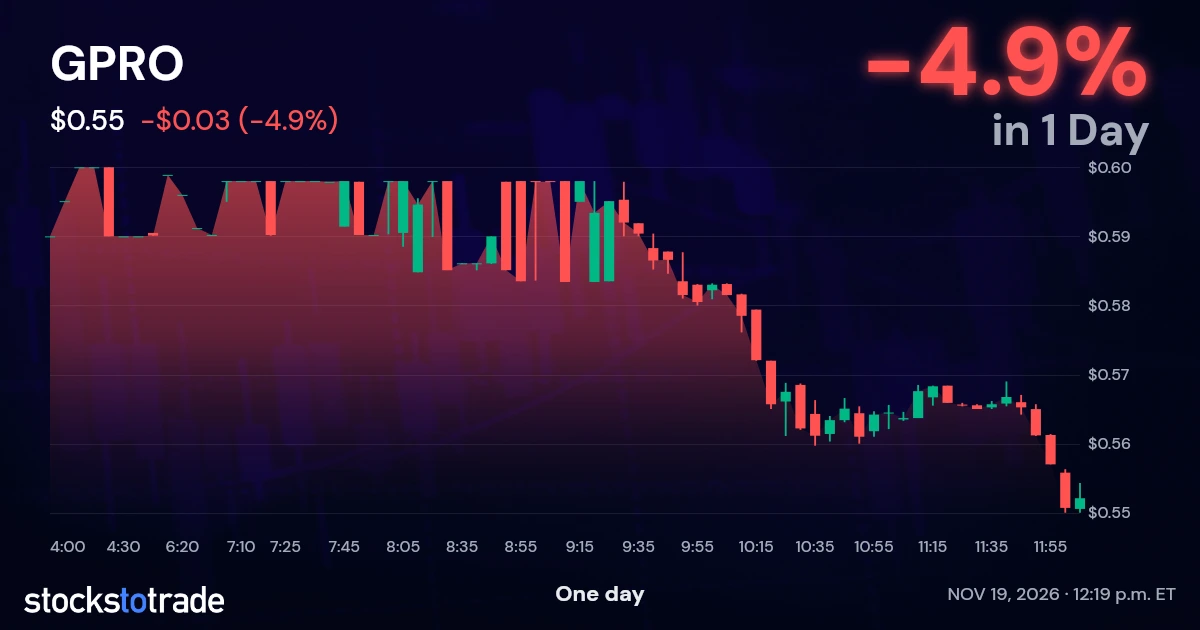
GPRO Candlestick Chart

Why GoPro Stock Is Falling Today

GoPro (NASDAQ: GPRO) fell 5% to $0.55 during regular trading hours today. No fresh business announcement or specific economic event explains the selling. Results released earlier this week showed quarterly revenue of $96.2 million and a loss of $85.8 million.

What GoPro Inc. Does

GoPro makes action cameras used to record outdoor sports and other activities. Weaker consumer demand can mean fewer camera sales, leaving less revenue to cover business costs.

GoPro Shares Retreat From around $1.00

Shares traded around $1.00 a month ago, putting today’s annual-low area within an ongoing retreat. The session high came before regular trading began. GoPro experienced a daily move this large as recently as the prior session, so sharp daily swings are already part of its recent history.

Quick Financial Overview

GoPro generates sales but loses money, and its $119.5M stock-market value makes it a micro-cap, meaning a very small public company. It held $33.5M in cash and cash equivalents, meaning cash the company can spend, as of September 30, 2026. That money covers about twenty months at the latest quarter’s operating spending rate.

GoPro Sales and Business Costs

Camera sales did not cover the company’s total reported costs. That leaves the business dependent on its cash while it works toward the proposed merger.

GoPro Operating Cash Spending

GoPro used $5.1M in its ordinary business operations during the quarter. This cash spending differs from the accounting loss because some reported expenses do not consume cash immediately.

GoPro Share Offering Disclosures

Recent prospectuses, documents explaining investments such as shares offered for sale, require a check of whether they cover new shares or existing holders’ resales. Only new issuance reduces current holders’ ownership percentage. The disclosures alone do not establish the size of any completed sale.

GoPro Stock Is down 65% Over a Year

GoPro’s longer chart shows a drop, then a spike, then a drop, leaving shares near their annual low. The stock is down 44% over six months and down 65% over a year.

Trading Perspective

The annual high around $2.00 is a distant recovery reference. Shares already trade in the under 60 cents risk area, so that zone cannot be described as a level where earlier declines have stopped.


GoPro Merger Deadline Extended

GoPro agreed in September to merge with Starman Optical, its proposed merger partner. The companies later extended their completion deadline to March 31, 2027. That is a contractual deadline, not a guaranteed closing date.

GoPro Withholds Financial Forecasts

GoPro said earlier this week that the proposed merger remained on track. Because of the pending deal, it provided no financial forecast or earnings conference call.

Conclusion

Completion by the extended merger deadline would remove deal uncertainty, while another delay or failure would leave holders exposed to GoPro’s standalone business risks. Stronger consumer demand could improve camera-sales expectations; weaker demand would pressure them. The reported cash position covers the wait at the recent spending rate, without removing transaction risk.

This is stock news, not investment advice. Timothy Sykes News delivers real-time stock market news focused on key catalysts driving short-term price movements. Our content is tailored for active traders and investors seeking to capitalize on rapid price fluctuations, particularly in volatile sectors like penny stocks. Readers come to us for detailed coverage on earnings reports, mergers, FDA approvals, new contracts, and unusual trading volumes that can trigger significant short-term price action. Some users utilize our news to explain sudden stock movements, while others rely on it for diligent research into potential investment opportunities.

Dive deeper into the world of trading with Timothy Sykes, renowned for his expertise in penny stocks. Explore his top picks and discover the strategies that have propelled him to success with these articles:

Once you’ve got some stocks on watch, elevate your trading game with StocksToTrade the ultimate platform for traders. With specialized tools for swing and day trading, StocksToTrade will guide you through the market’s twists and turns.
Dig into StocksToTrade’s watchlists here:



How much has this post helped you?


Leave a reply

* Results are not typical and will vary from person to person. Making money trading stocks takes time, dedication, and hard work. There are inherent risks involved with investing in the stock market, including the loss of your investment. Past performance in the market is not indicative of future results. Any investment is at your own risk. See Terms of Service here

The available research on day trading suggests that most active traders lose money. Fees and overtrading are major contributors to these losses.

A 2000 study called “Trading is Hazardous to Your Wealth: The Common Stock Investment Performance of Individual Investors” evaluated 66,465 U.S. households that held stocks from 1991 to 1996. The households that traded most averaged an 11.4% annual return during a period where the overall market gained 17.9%. These lower returns were attributed to overconfidence.

A 2014 paper (revised 2019) titled “Learning Fast or Slow?” analyzed the complete transaction history of the Taiwan Stock Exchange between 1992 and 2006. It looked at the ongoing performance of day traders in this sample, and found that 97% of day traders can expect to lose money from trading, and more than 90% of all day trading volume can be traced to investors who predictably lose money. Additionally, it tied the behavior of gamblers and drivers who get more speeding tickets to overtrading, and cited studies showing that legalized gambling has an inverse effect on trading volume.

A 2019 research study (revised 2020) called “Day Trading for a Living?” observed 19,646 Brazilian futures contract traders who started day trading from 2013 to 2015, and recorded two years of their trading activity. The study authors found that 97% of traders with more than 300 days actively trading lost money, and only 1.1% earned more than the Brazilian minimum wage ($16 USD per day). They hypothesized that the greater returns shown in previous studies did not differentiate between frequent day traders and those who traded rarely, and that more frequent trading activity decreases the chance of profitability.

These studies show the wide variance of the available data on day trading profitability. One thing that seems clear from the research is that most day traders lose money .

Millionaire Media 66 W Flagler St. Ste. 900 Miami, FL 33130 United States (888) 878-3621 This is for information purposes only as Millionaire Media LLC nor Timothy Sykes is registered as a securities broker-dealer or an investment adviser. No information herein is intended as securities brokerage, investment, tax, accounting or legal advice, as an offer or solicitation of an offer to sell or buy, or as an endorsement, recommendation or sponsorship of any company, security or fund. Millionaire Media LLC and Timothy Sykes cannot and does not assess, verify or guarantee the adequacy, accuracy or completeness of any information, the suitability or profitability of any particular investment, or the potential value of any investment or informational source. The reader bears responsibility for his/her own investment research and decisions, should seek the advice of a qualified securities professional before making any investment, and investigate and fully understand any and all risks before investing. Millionaire Media LLC and Timothy Sykes in no way warrants the solvency, financial condition, or investment advisability of any of the securities mentioned in communications or websites. In addition, Millionaire Media LLC and Timothy Sykes accepts no liability whatsoever for any direct or consequential loss arising from any use of this information. This information is not intended to be used as the sole basis of any investment decision, nor should it be construed as advice designed to meet the investment needs of any particular investor. Past performance is not necessarily indicative of future returns.

Citations for Disclaimer

Barber, Brad M. and Odean, Terrance, Trading is Hazardous to Your Wealth: The Common Stock Investment Performance of Individual Investors. Available at SSRN: “Day Trading for a Living?”

Barber, Brad M. and Lee, Yi-Tsung and Liu, Yu-Jane and Odean, Terrance and Zhang, Ke, Learning Fast or Slow? (May 28, 2019). Forthcoming: Review of Asset Pricing Studies, Available at SSRN: “https://ssrn.com/abstract=2535636”

Chague, Fernando and De-Losso, Rodrigo and Giovannetti, Bruno, Day Trading for a Living? (June 11, 2020). Available at SSRN: “https://ssrn.com/abstract=3423101”