



In trading, long-term success comes down to one or two big mindset shifts.
The good news is that you get to choose your own path.
But you have to make a decision…

Will you do, for a short period of time, what most people won’t…
… to live a life of freedom that most people can’t?
Understand that trading is a competition (two, actually).
The first competition is you versus you.
But at the end of the day, you are competing with other traders.
The VAST majority of your competitors simply aren’t willing to put in the time required. They just don’t want it bad enough.
To succeed, you MUST embrace this…
Table of Contents
Short-Term Sacrifice
Trading is TRULY great if you make the short-term sacrifice to learn the rules.

Understand that the information, the knowledge you need to succeed, is not infinite. A lot of people get scared away because it seems like there’s so much to learn.
I assure you that most people are capable of learning what they need to know in two to three years.
Don’t take that the wrong way. I can’t guarantee the time frame.
I have zero idea what your work ethic is, okay? It might take you less time. But it could take longer.
For example, I have one student who took ten years before he sized up.
Still, I believe you have just as much opportunity to succeed at trading as anyone else…
- IF you are willing to sacrifice time to grow your knowledge account
- IF you are willing to practice with small positions first, and…
- IF you learn the rules and stick to them
The problem is that most people underestimate…
The Power of Delayed Gratification

Even after you learn the rules, you MUST practice playing by the rules. Then, over time, you can reap the rewards.
One of the all-time great investors, Warren Buffet, famously said…
“The stock market is a device for transferring money from the patient to the impatient.”
Investing and trading are not the same, right?
What I teach is different from the value investing strategies that Warren Buffett and Charlie Munger used to grow Berkshire Hathaway (NYSE: BRK.A).
But delayed gratification applies to trading, too (especially if you’re new).
The money you make or lose in the beginning means almost nothing.
That is, unless you blow up your account trying to trade big position sizes before you’re ready. Or if you don’t learn to cut losses quickly.
That’s why getting an education is SO important.
Every single trade you make gives you data. But you MUST focus on the process and delay the monetary gratification.
It’s up to you to…
Choose the Right Path
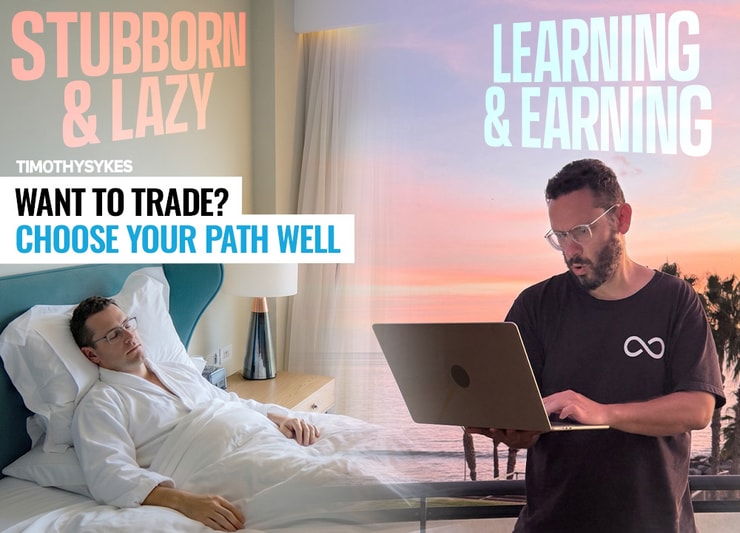
Which path do you want to take?
Learn and eventually earn (over time), so you can build something beautiful for yourself and your family?
Or…
Be stubborn, bitter, and lazy?
Obviously, I can’t guarantee your success. There IS no guarantee in trading, except this:
People who fail are those who…
- Don’t study
- Don’t learn from their losses
- Keep repeating the same mistakes over and over, and….
- Quit (or blow up their account)
I’m being straight with you when I say that not everyone will succeed.
But I strongly believe that anyone CAN succeed.
One final thought on this…
Making Mistakes Does NOT Disqualify You From Success
In fact, if you’re not willing to make mistakes, you will get NOWHERE in trading.
So many people try to be perfect (it drives me crazy).
You are NOT going to win 100% of the time. You don’t even have to win 50% of the time if you understand how to cut losses.
But you’ll never even get started if you’re not willing to make mistakes.
Mistakes are the best way to learn!
Trade small and make mistakes. Learn from EVERY mistake, collect data, and get better.
Millionaire Moves
Strati, our Inner Circle lead trainer, had a nice win trading AI OKTO CORP. (NASDAQ: AIOK) on Tuesday (Oct. 27).
Inner Circle lead trainer @Stratataaa made $15K today, but his growth hasn’t just been in the market. He credits @timothysykes' no-sugarcoating approach with helping him become a better trader, teacher, and person.
And in just 2 weeks, the Inner Circle is heading to Vegas! pic.twitter.com/NQaUpjFBSK
— StocksToTrade (@StocksToTrade) October 27, 2026
In case you don’t know, Strati was a gym teacher before he turned to trading.
According to Strati, my “no sugarcoating” approach helped him to become a better trader AND a better teacher.
I can tell you that Strati is a GREAT teacher in his own right. I’m proud of the hard work he’s put in.
Pay attention, because this is super important…
Strati has struggled at times, just like every one of my millionaire students. What he didn’t do was quit, get bitter, or get lazy.
He chose his path well. Here’s what Strati did:
- Study every day
- Practice (Strati has done everything from sizing down to paper trading when things aren’t working)
- Keep a positive mindset
How did Strati get started?
He got cocky after a single win, then lost it all about a week later. That’s when his inner teacher kicked in. He realized education was the path to success.
Do you have what it takes to become one of my millionaire students?
If you’re ready to choose the path of education and dedication…
Apply for my Trading Challenge today.
Key Takeaway
If you truly want to gain freedom through trading, it’s going to take time.
You will have to adapt to changing markets.
You will have to learn a new strategy when your favorite strategy stops working.
You will probably have to go through different market cycles more than once before you hit your goals.
But the most important thing to understand is that YOU get to choose.
Will you choose the path of education, opportunity, and continued growth?
You got this (I believe in you).
Cheers,
– Tim Sykes

Leave a reply